From The Vault:

Volume 5 Number 4 – Fall 2025

A NOTE FROM YOUR DISTRICT HISTORIAN

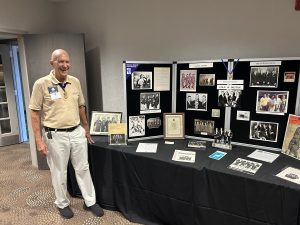
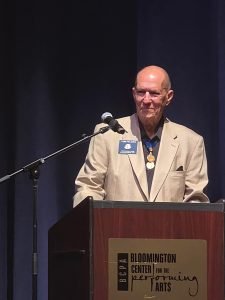
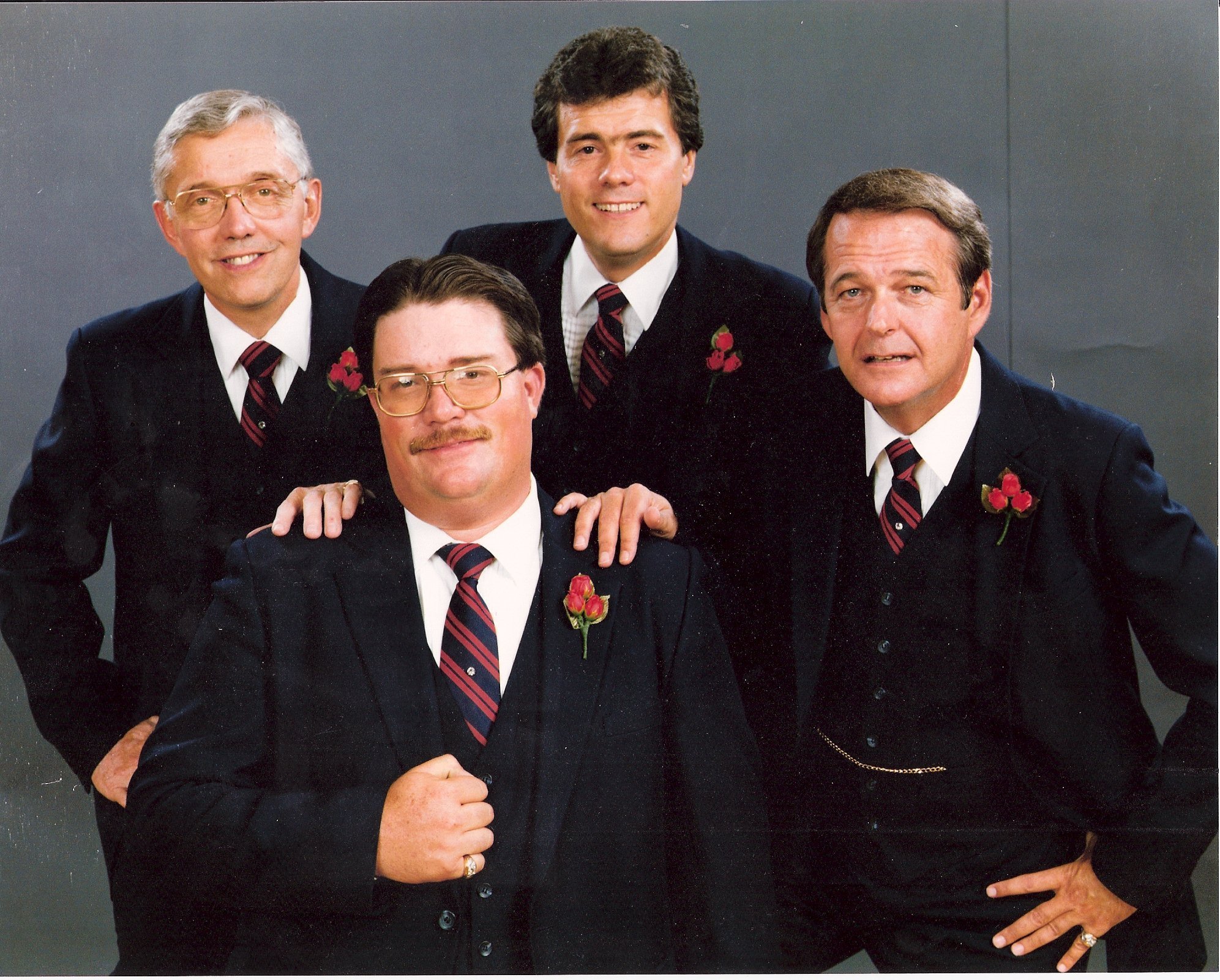
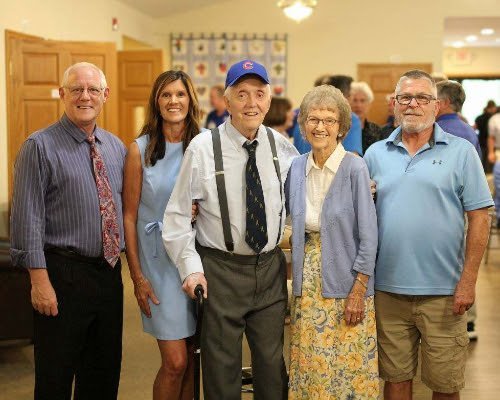
Greetings Friends of the Illinois District!  I hope this newsletter finds you well.  Once again we gathered in Bloomington in September for our fall convention, although this one had significance for me as district historian.   Joining us from around the country were members of the Renegades family, including the sole surviving member – Bass Tom Felgen.  The cause for celebration was to honor The Four Renegades as they marked the 60th anniversary of their international championship in Boston back in 1965.

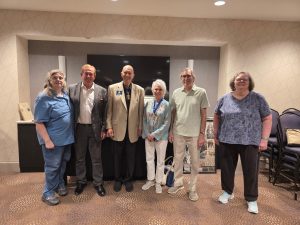
A special display was set up in the historical room with unique items from the district archives that had been donated over the years by members of the quartet.  After the chorus contest, convention attendees had the opportunity to visit with members of the family, including Tom Felgen and the children of tenor Buzz Haeger, lead Ben Williams, and bari Jim Foley.  To visit with these remarkable individuals who have a special connection to our district history is a memory that will live with me forever.

Speaking of “living” history – in this issue, we honor a long-time and well-known barbershopper, spotlight a popular past champion quartet, explore a time when barbershopping and the military worked together, and feature a unique artifact from the early days of the Society.  Plus, we remember a group of young men from the early ’80s and turn the clock back 50 years in our retro recording.  My sincerest thanks to Dr. Tom Woodall, Andy Isbell, and Scott Diehl for assisting me with the articles for this issue.

I hope you enjoy this walk through history.

Sing-cerely,

Rich Hansen

Illinois District Historian

Tom Woodall

BARBERSHOP ICON

(taken from the QCA Archives & recollections by Tom Woodall)

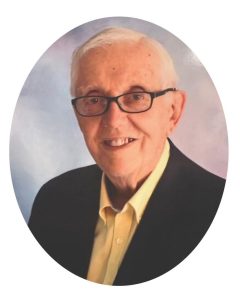
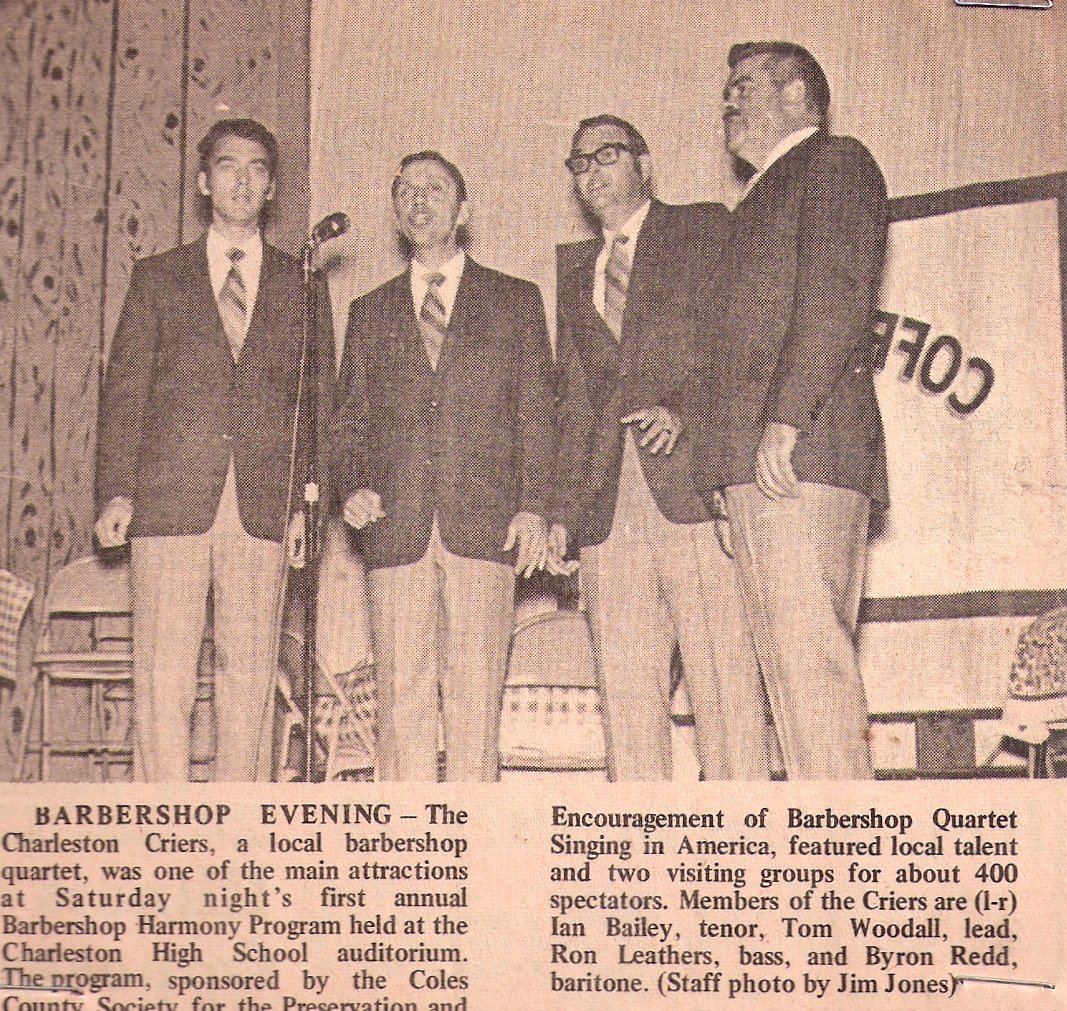
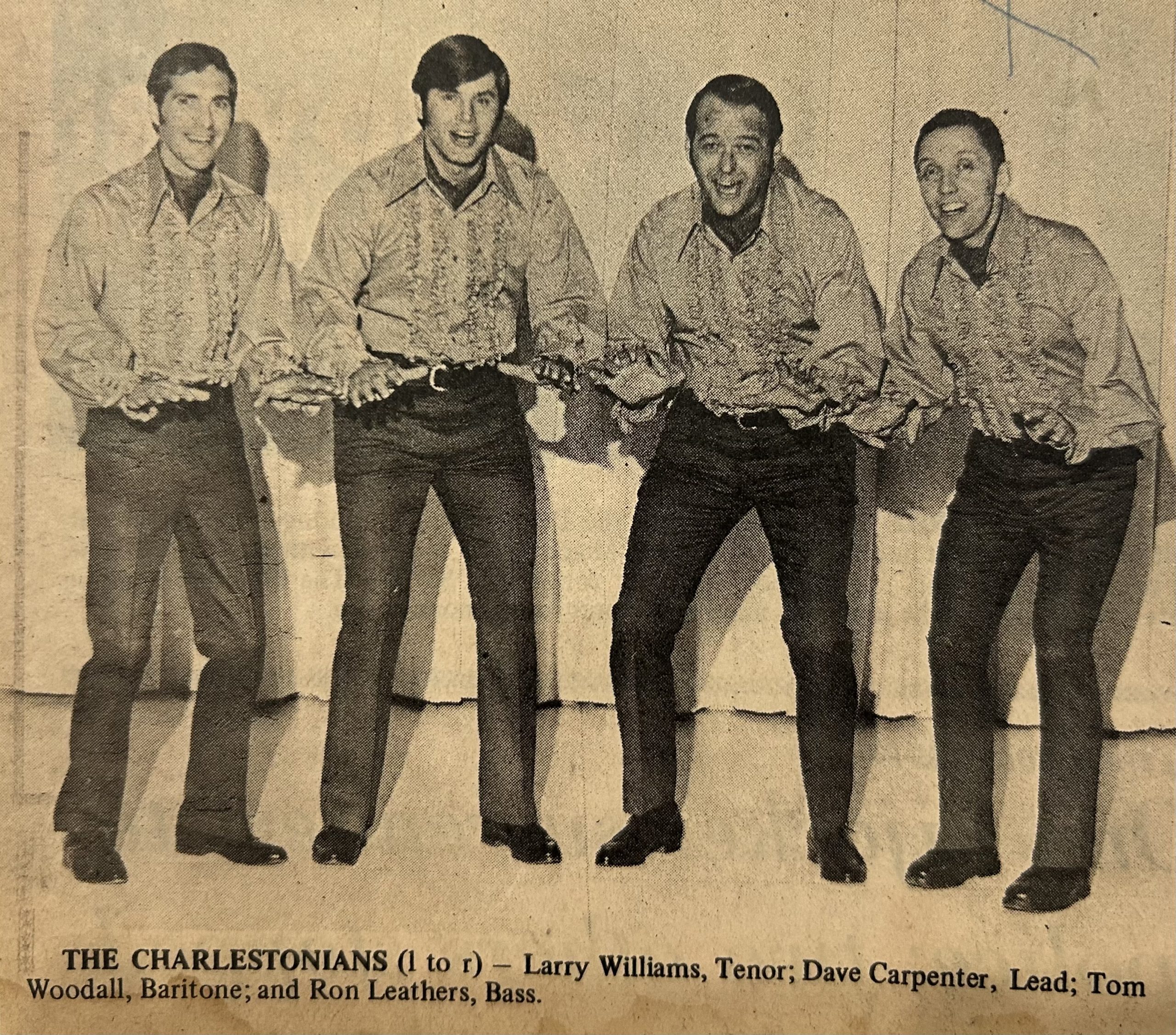
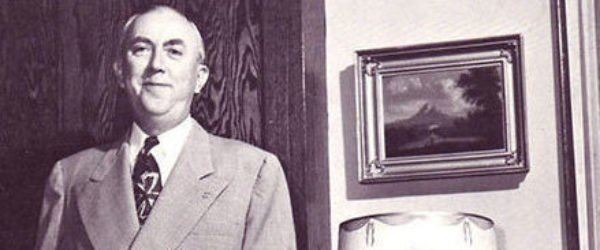
Dr. Tom Woodall joined the Society in 1960 as a member of the Sterling-Rock Falls Chapter.  So impressed was he with the harmony that as a first date, he thought of bringing a young girl to a barbershop show.  Marge and Tom have been married over 65 years!  She has followed Tom through four chapters, one of which – the Brookings South Dakota Chapter, was founded in the basement of their home in 1962.

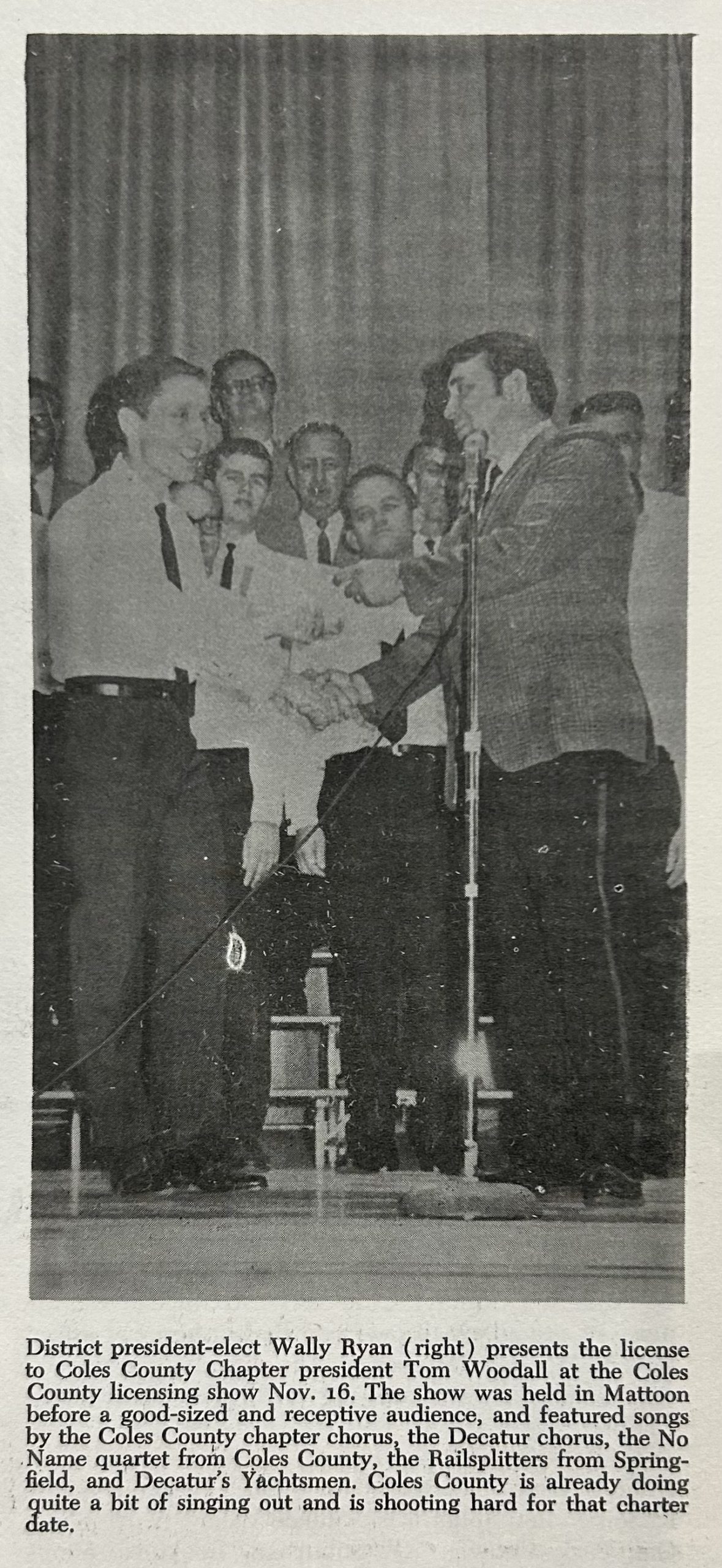
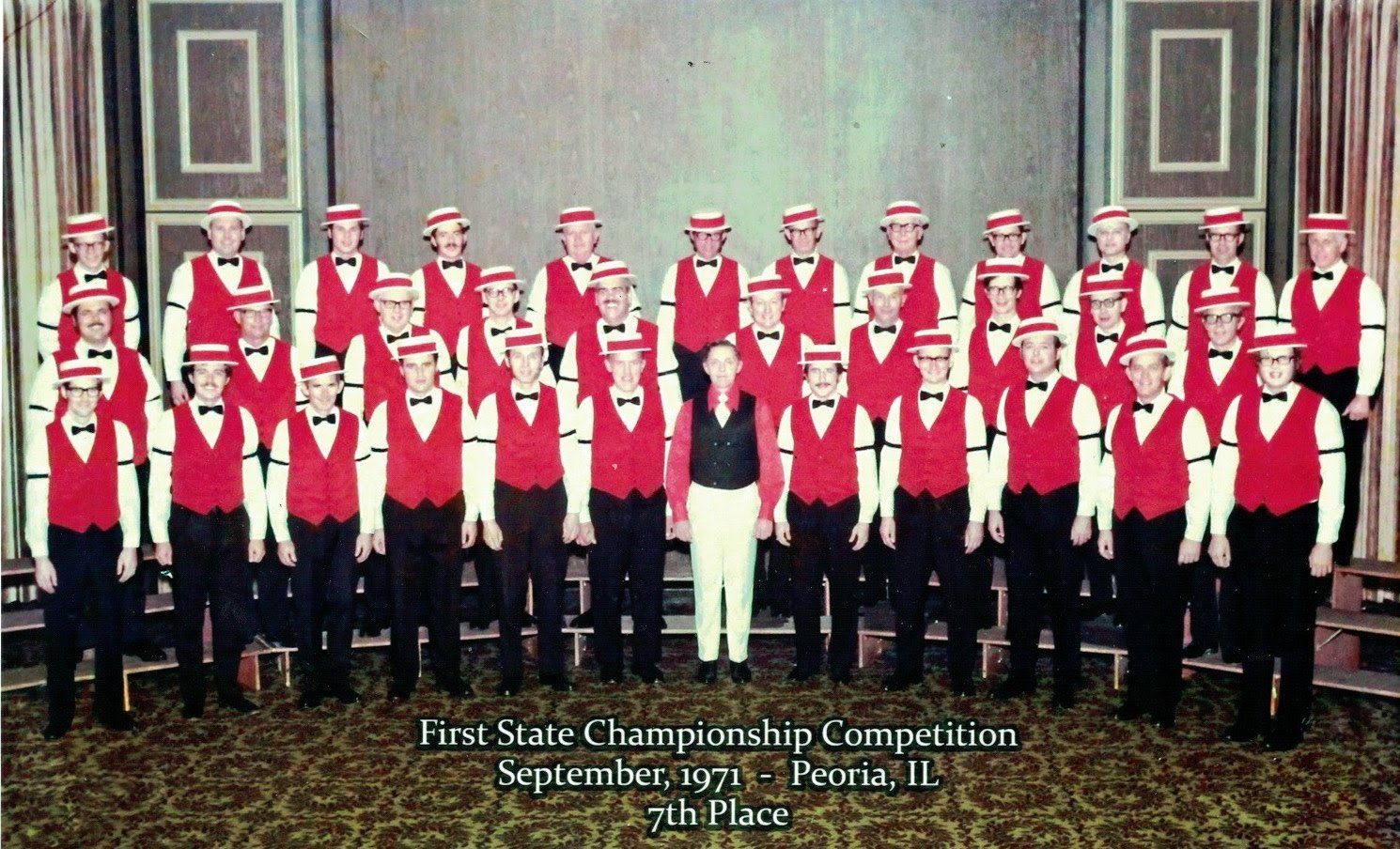
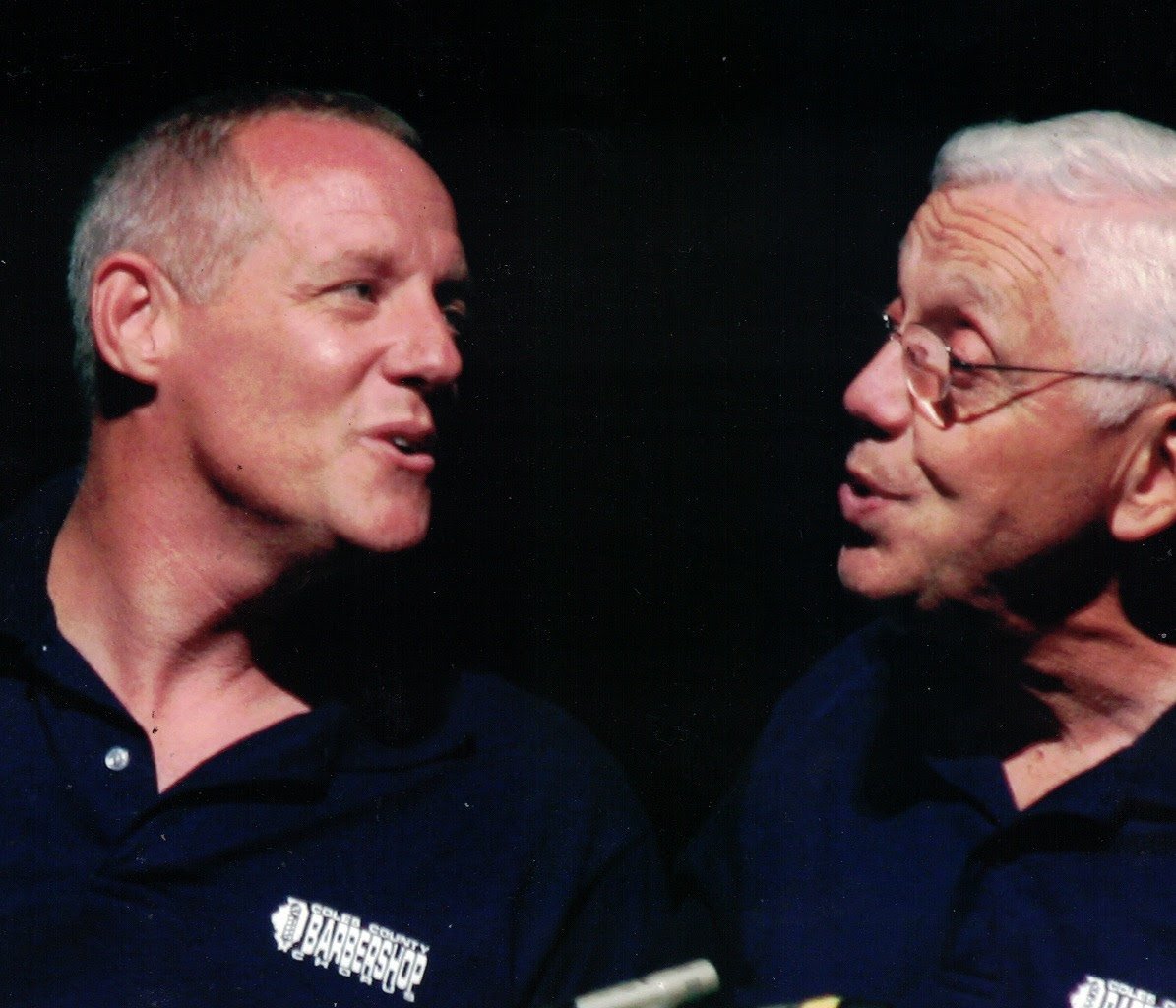
Later, Tom got a job teaching and coaching at Eastern Illinois University.  While there was a local barbershop chapter (Charleston) in town, it had only a few aging members and the chapter was no longer affiliated with the Society.  Tom thought the time was right for a fresh start and in 1969 laid the groundwork for what would become the Coles County Chorus, officially licensed in 1970.  Tom would serve as its first, and longest serving director.

Through the years, Tom has been a top competitor in Illinois District contests. He has been a member of over a dozen quartets, beginning in 1959 with the Sterling Four, whose members included Lyle Dirks, the grandfather of District President Ben Dirks.  He sang with fellow Coles County members Stan McMorris, Gary Nohren, and Ron Leathers in Sentimental Journey throughout the 1980s and with Gary, Ron, and Tom’s son Tim in the Tri-Counts in the 1990s.  Contest audiences eagerly awaited Coles County’s appearance, knowing that madcap routines and themed packages were a hallmark of the chapter.

Besides being the founder and long-time musical director of the chapter, Tom has also served in the capacity of Chapter President, Music VP, Program VP, Membership VP, YIH VP, and Board Member.  At the district level, people will remember Tom for gathering various quartet champions together and organizing the “Sing With a Champ” hour at conventions.  He also was a frequent clinician at the annual Illinois District Academy of Harmony (IDAH) workshops.

Tom also served as a judge with the Society for many years.  His interest in the Society’s judging program dates back to 1967 when he became a candidate in the “Harmony Accuracy” category.  He became certified in 1972 and with the total revision of the judging program in 1993, became certified in the new “Singing” category.  Over the years, Tom has judged more than fifty District, Divisional, and International Preliminary contests, as well as three Internationals (1974 in Kansas City, 1975 in Indianapolis, & 1994 in Pittsburgh).

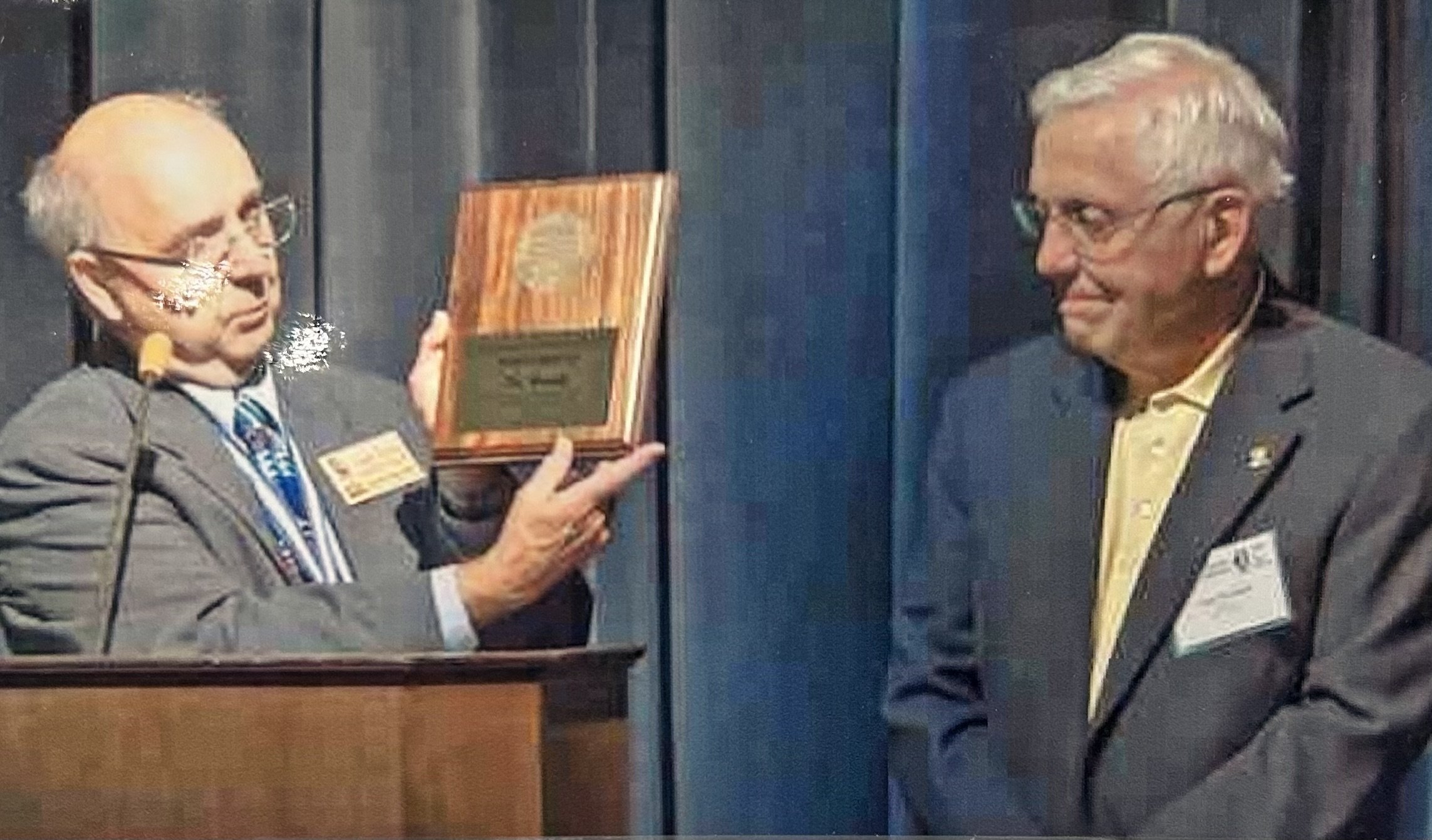
As a “Pied Piper” of barbershop harmony, Tom has over 25 Man-of-Note Awards to his name, has received Chapter and District Barbershopper of Year Awards, was named an “ABE” (Award for Barbershop Excellence) winner in 1971 and was honored as the QCA’s 1993 “Music Man.”

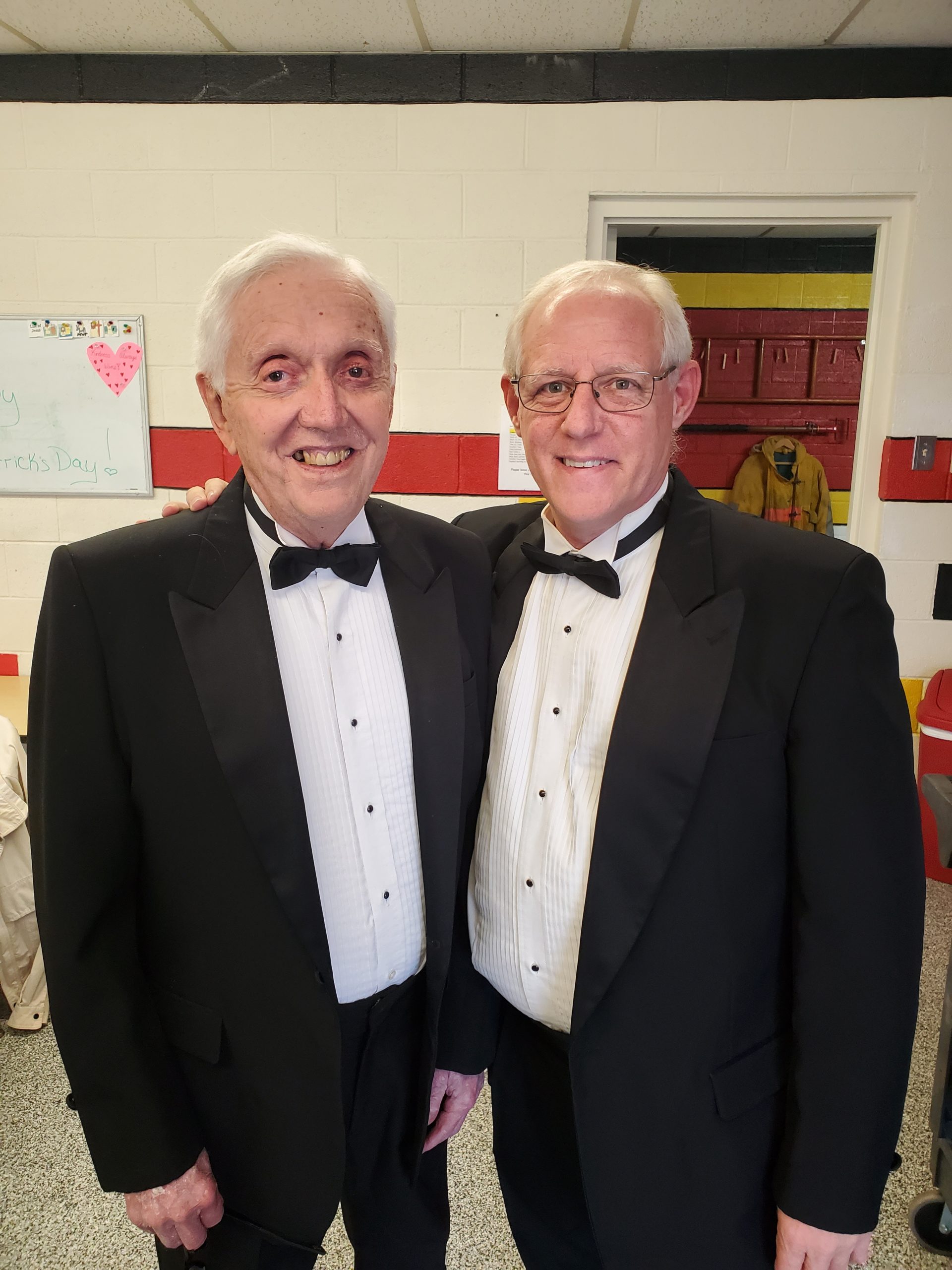
Tom has also penned numerous arrangements for his chapter over the years.  Tom credits his love of singing and music in general to his father (also Tom).  A music teacher, Tom Sr. insisted that his son learn music from the ground up…the classic composers, taking piano lessons…the whole gamut.  From this background came his love and appreciation of music which later encompassed barbershop harmony as well.  This love transcended the generations, as he often sang alongside his son Tim Woodall (now the co-director of the Coles County Chorus and district champion with South of Normal in 2017.)

Whether as director, judge, teacher, or just plain singer, Dr. Tom Woodall has accomplished a great deal in the barbershop world and serves as a shining example of what it means to give your best in all that you do.  Thank you Tom!
 

QCA Spotlight

FASCINATIN' RHYTHM (1992)

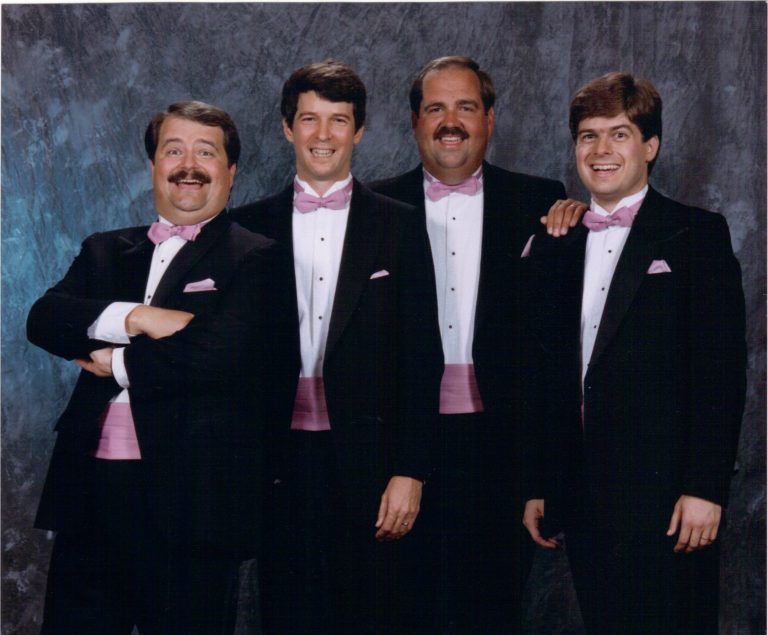
In this issue, we spotlight a quartet with some familiar faces – Scott Brooks, John Muir, Mike Brooks, and Andy Isbell.  They won the district championship in 1992 and were a popular group during the years they sang together.    

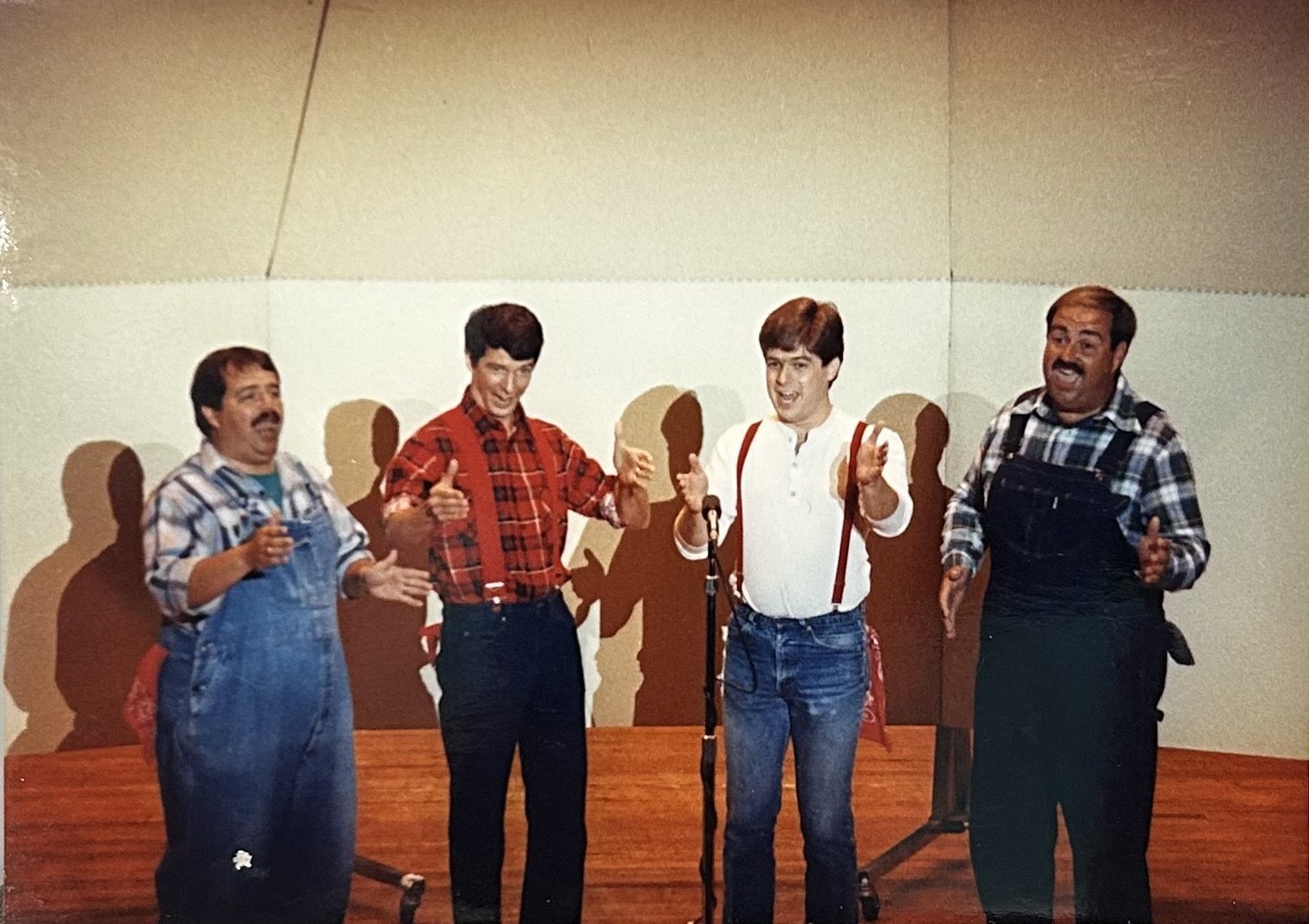
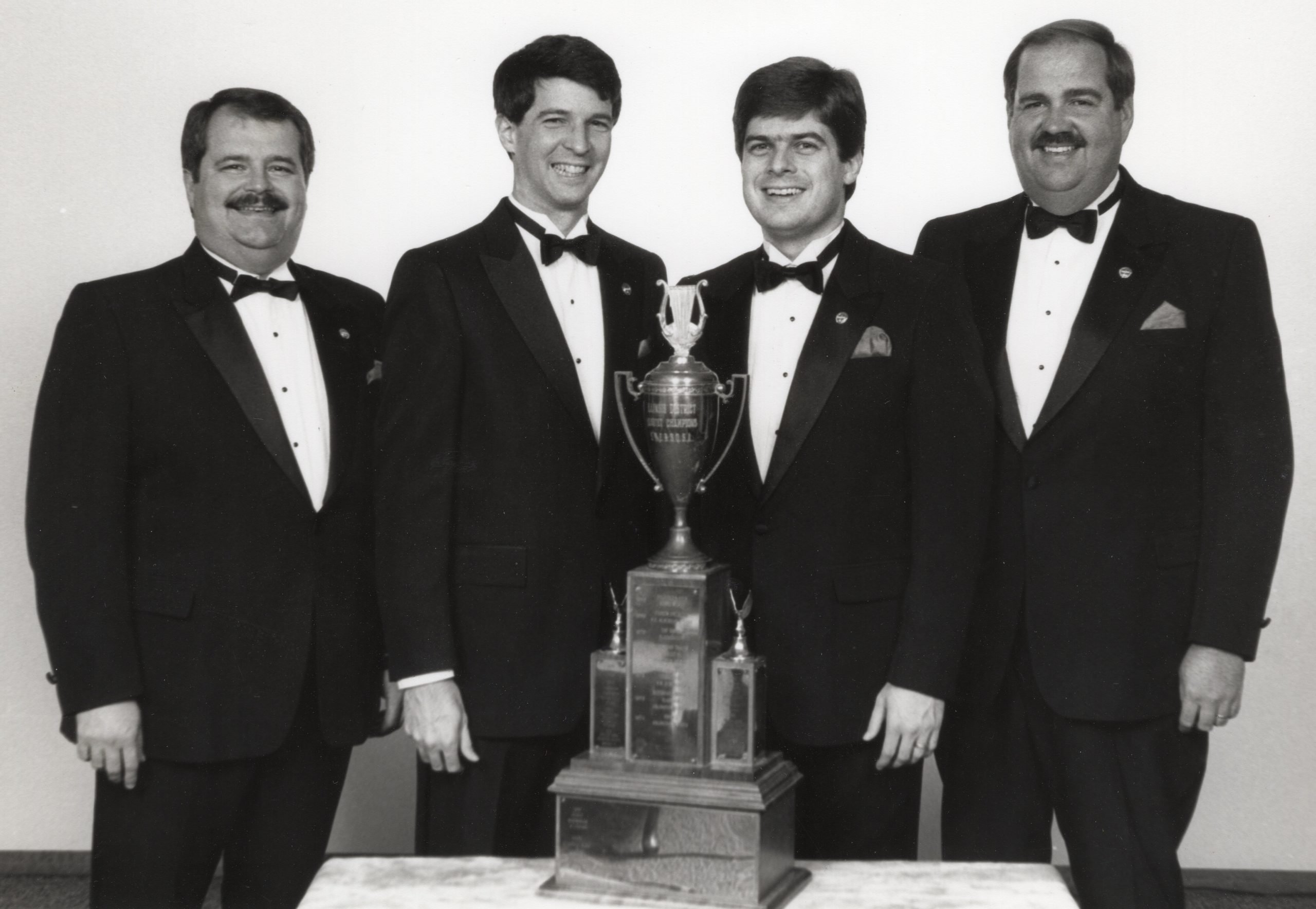
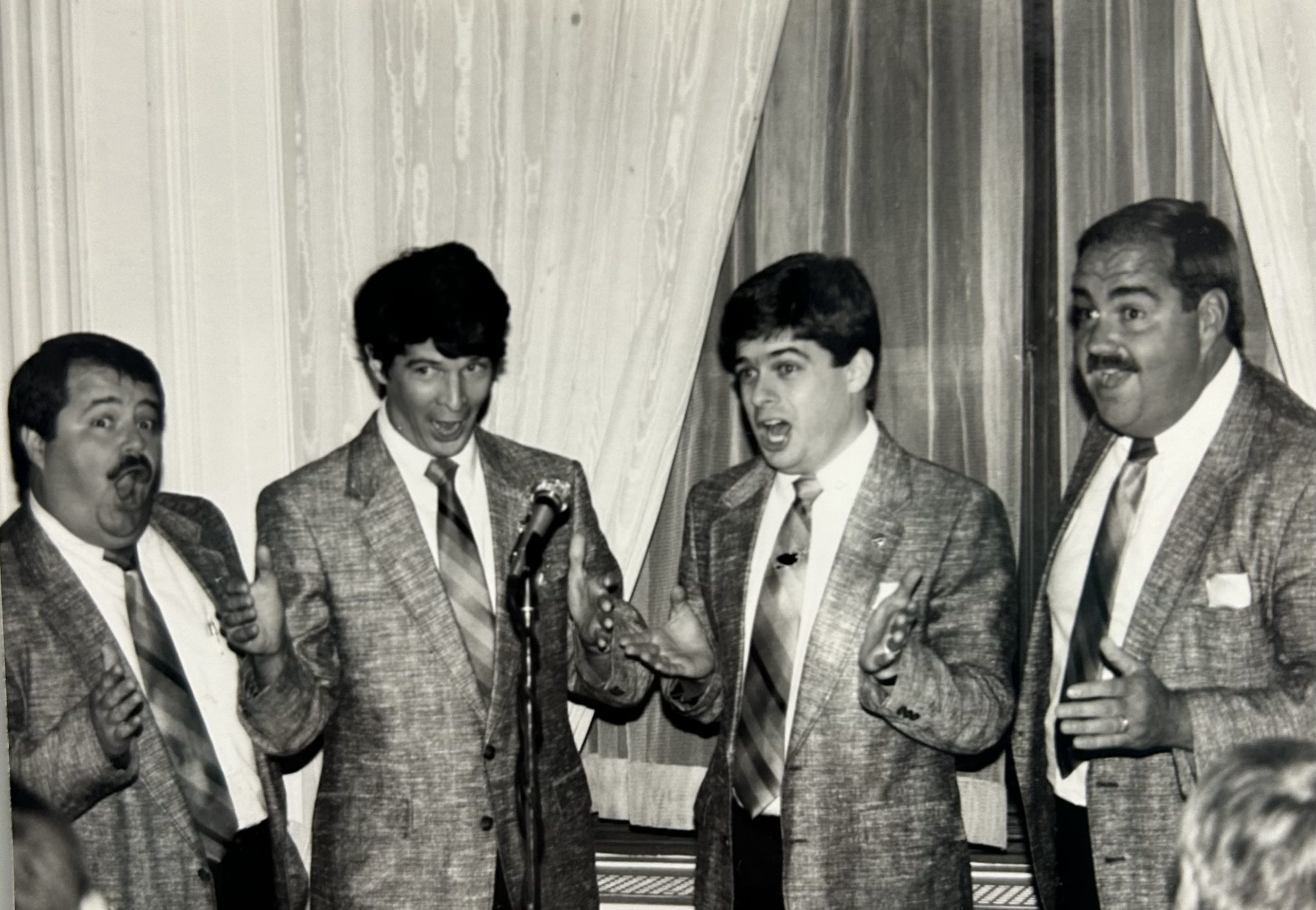
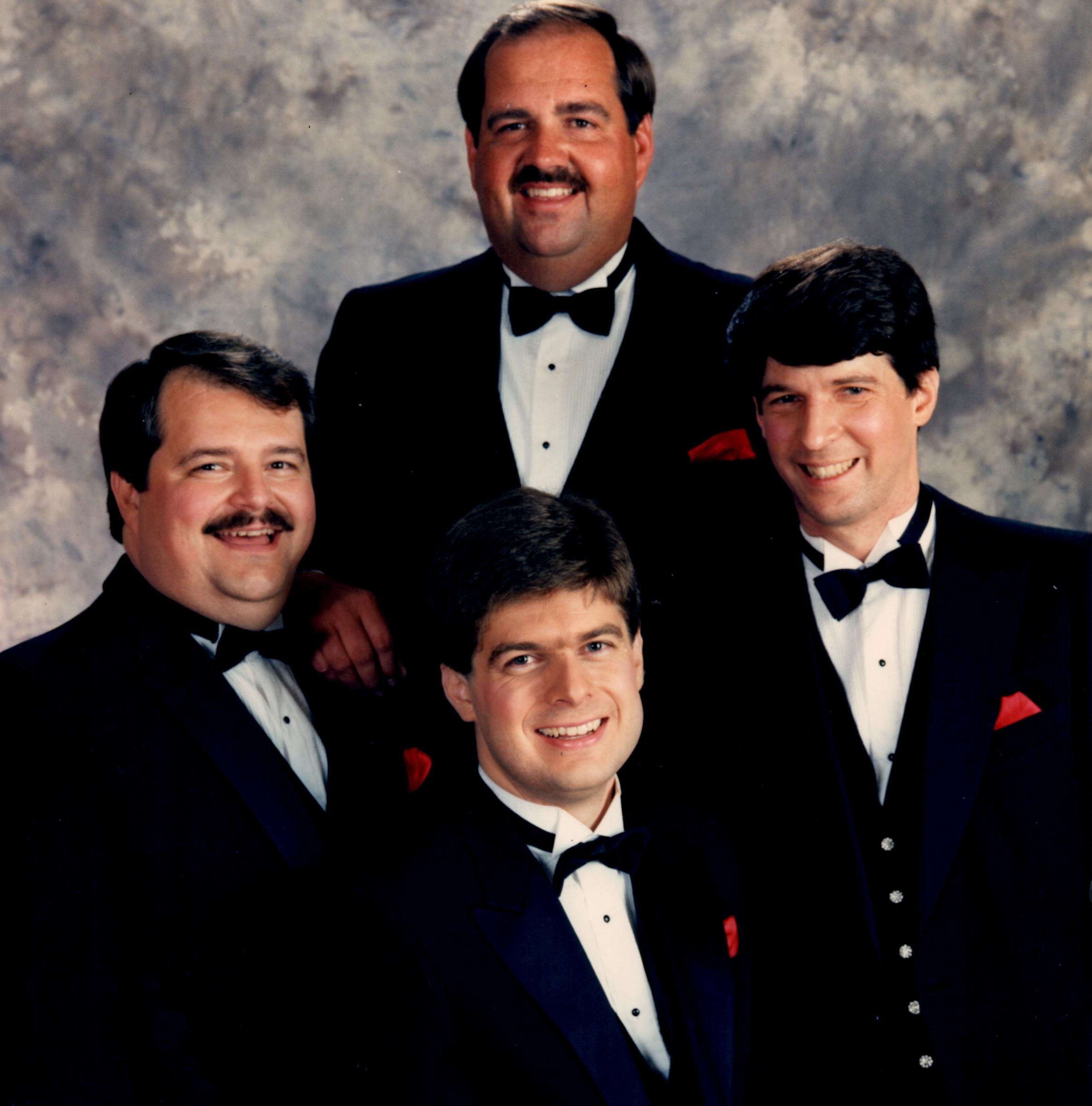
The story of Fascinatin’ Rhythm goes back to the summer of 1990, shortly after the breakup of Four Star Revue (see FTV Fall 2021 Issue).  By that time Andy replaced Vern Knapp in the quartet.  Lead Drayton Justus moved away shortly after the Spring 1990 contest. As John and Andy were still interested in singing together, they joined forces with two of the legendary Brooks brothers – Scott and Mike.  All four were singing with the Champaign-Urbana Illini Statesmen chorus, and John was the director. 

In their first contest (Fall of 1990), the group came in 5th.  They jumped two spots the following year, and won the district championship in 1992.  Although the group competed in the spring contest on four occasions, they never qualified for International.  They did, however, finish 3rd in the spring of 1991, which got them an invitation to go to the Buckeye Invitational in Ohio that summer. 

According to bass Andy Isbell, the group owed its popularity as a show quartet to an entertaining MC (Mike) and unique arrangements (courtesy of John).  The quartet kept a busy schedule, performing on several shows each year, and traveled all over the state, as well appearing on a couple of shows in Iowa, and one in Michigan.

In the fall of 1993, Scott decided he wanted to take a break from the quartet. John’s son Martin sang tenor on at least one show and at a retirement party for Andy’s father. Martin’s voice started changing in early 1994, and Scott decided he’d like to do one more contest, so the group did compete in the Spring of 1994.  Shortly thereafter, job responsibilities and family commitments prevented the guys from continuing and the quartet disbanded in the summer of 1994.  

We honor our 1992 (once and always) district quartet champions – Fascinatin’ Rhythm!

Military Barbershop

The year was 1951.  The world was in the throes of the Cold War, and Americans were fighting a “hot” war in Korea.  Many Illinois barbershoppers put their jobs aside and joined the fight.  In the August/September 1951 issue of the district publication Attacks & Releases, an article appeared that informed the membership that the Society had been working with the U.S. Army since the start of the war to establish barbershop quartets and choruses at Army bases throughout the country.

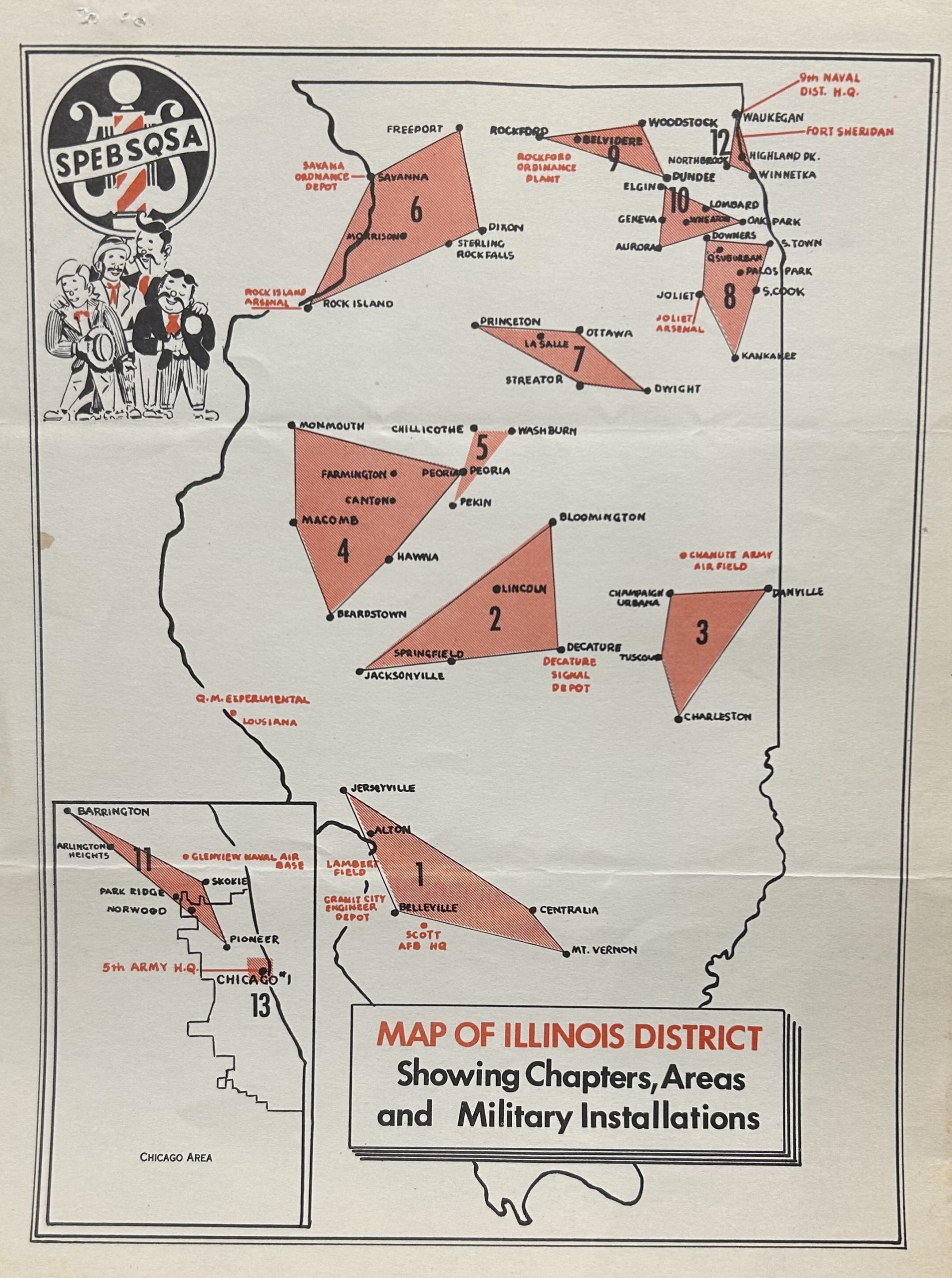
Soon thereafter, a letter was sent from District Secretary Charles Hecking to all chapter secretaries.  In his correspondence, Hecking urged all chapters to form an “Armed Forces Collaboration Committee.”  Each chapter was to seek out their nearest base and offer their services, be it furnishing a quartet or chorus to entertain troops and demonstrate the style, as well as inviting key officers and personnel to chapter shows and meetings.  Collaboration was to be initiated between the chapter committee and the Recreation/Special Service Officer located at each base.

So that chapters knew where the bases were located, Hecking included a map of the district, which showed each chapter (over 60 at that point!), and their nearest military installations.  The map resides in the district archives and is included in this article.  This is a great example of showing how barbershop music played a key role in the lives of those who were serving our country during a pivotal moment in history.

"Founder's Envelope"

The archives is a treasure trove for the barbershop enthusiast, and occasionally a piece is found that holds not only District, but Society significance.  So it is with this issue’s featured artifact.

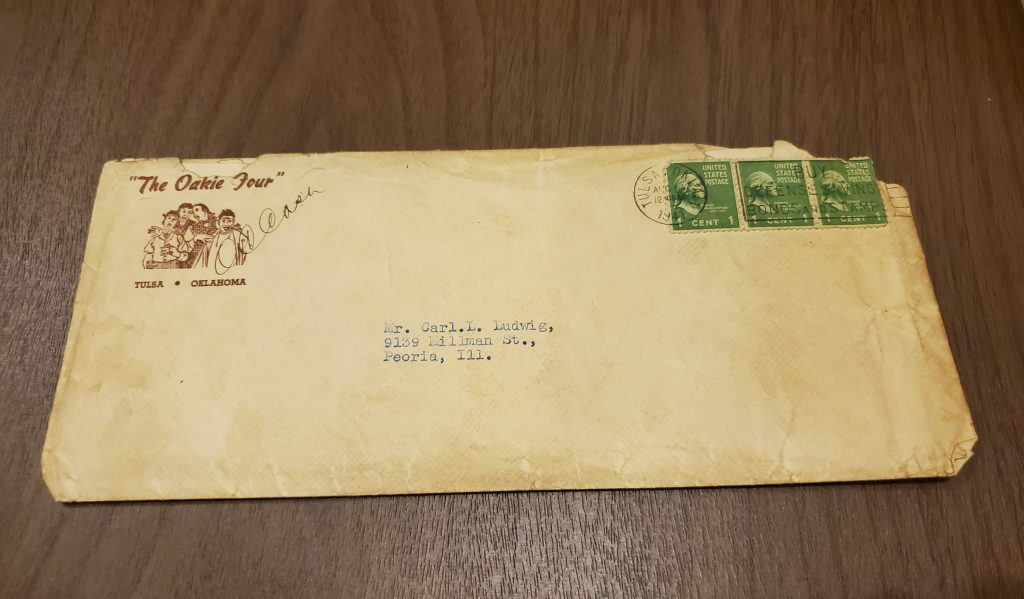
On the surface, it appears to be an old envelope.  However, under closer scrutiny it is revealed to be a stamped envelope mailed on August 14, 1941 with an illustration of the Oakie Four in the upper left hand corner with a surprise autograph – that of SPEBSQSA (now BHS) co-founder Owen Clifton (O.C.) Cash!

The envelope was mailed from Cash in Tulsa, Oklahoma to Mr. Carl Ludwig of Peoria.  Ludwig was the lead of the Gipps Amberlin Four quartet, which also featured Illinois District icon John Hanson (See FTV Summer 2022 Issue).  The bass of the group, John Hulit, is credited with saving the envelope until it was finally donated to the district archives by a member of the Peoria Chapter.

(Note – you could mail a letter from Oklahoma to Peoria for just three cents back then – each stamp is 1 cent each!  The good ol’ days…)


Second Generation

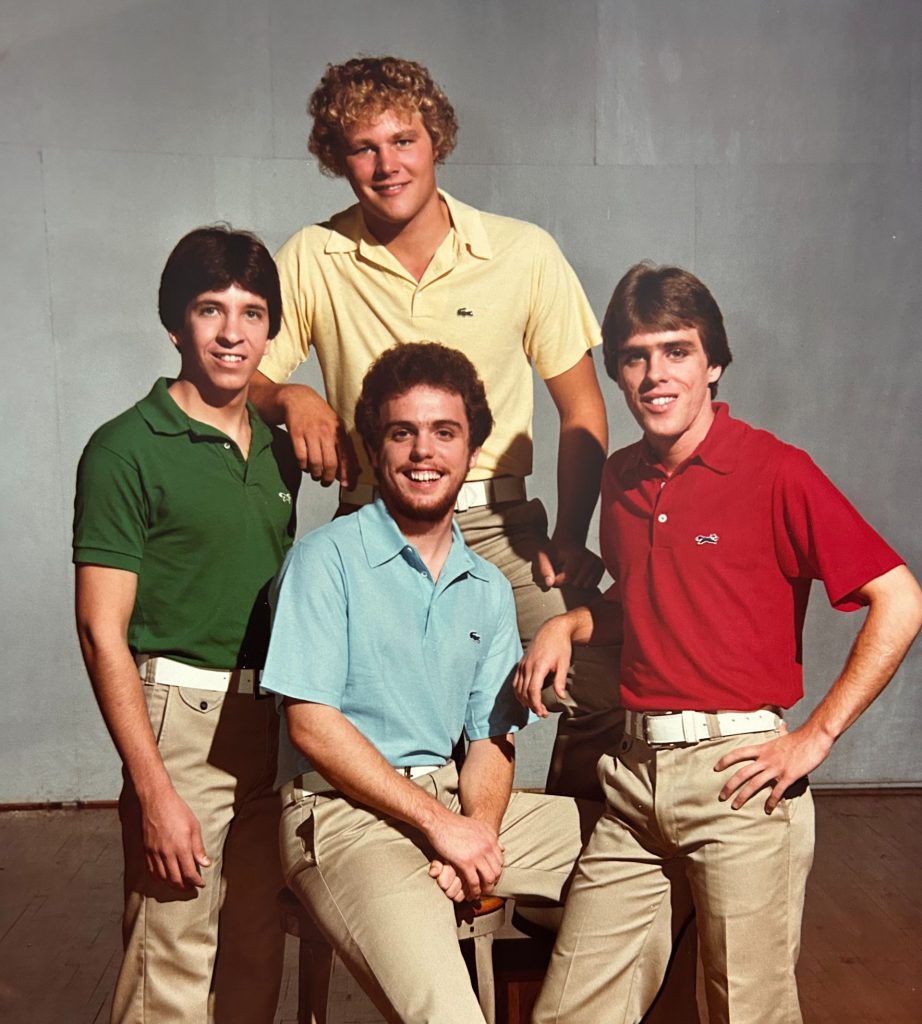
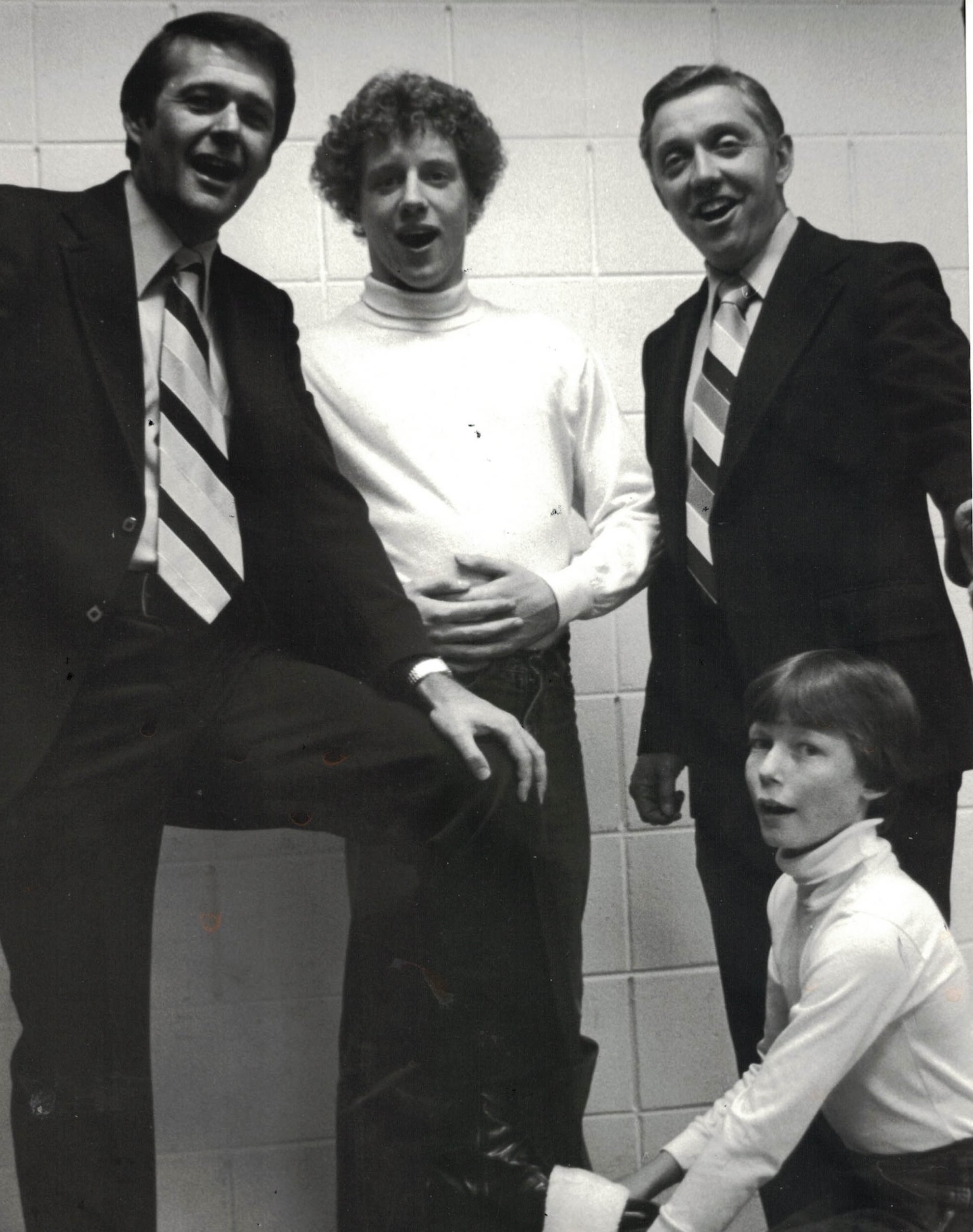
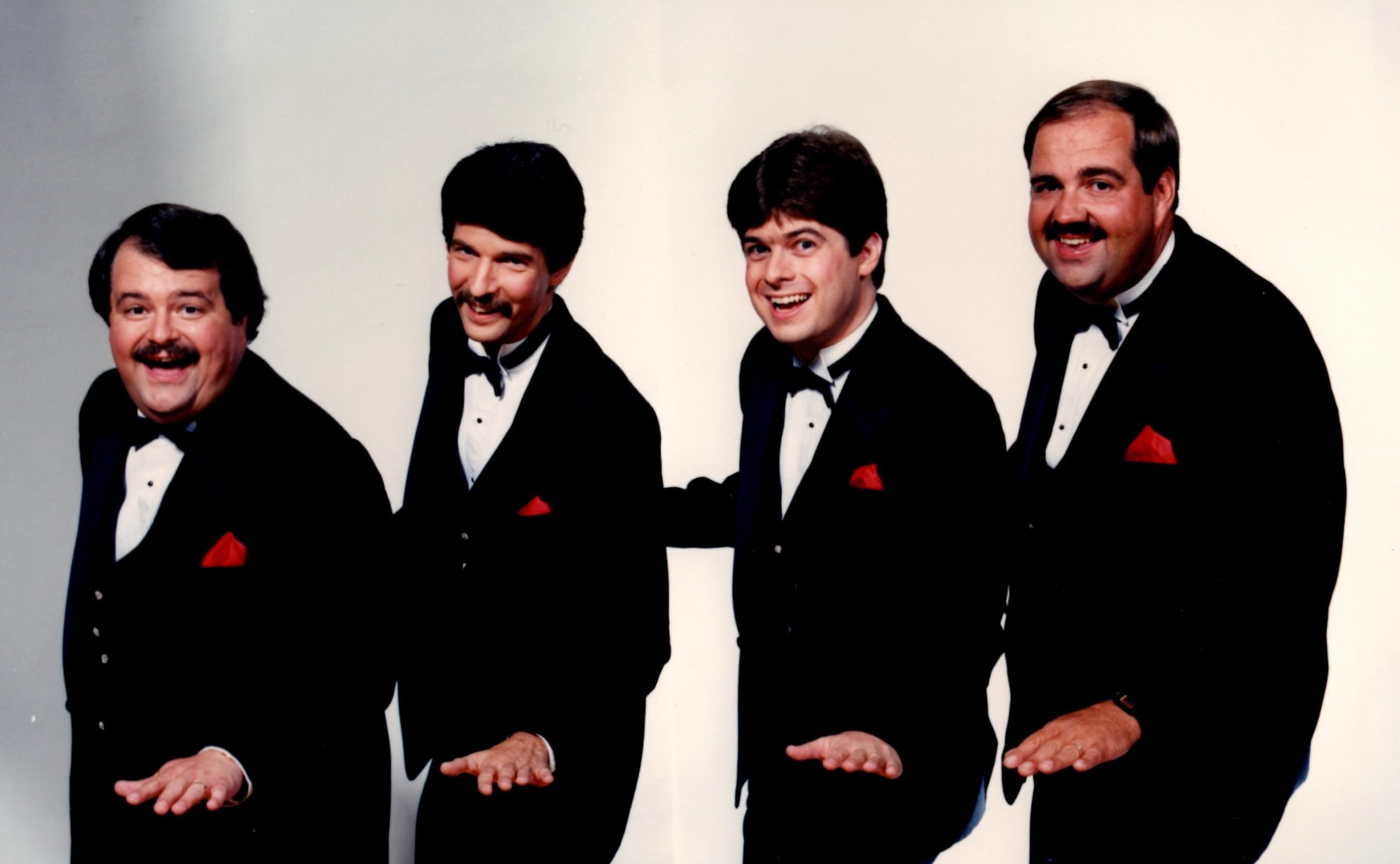
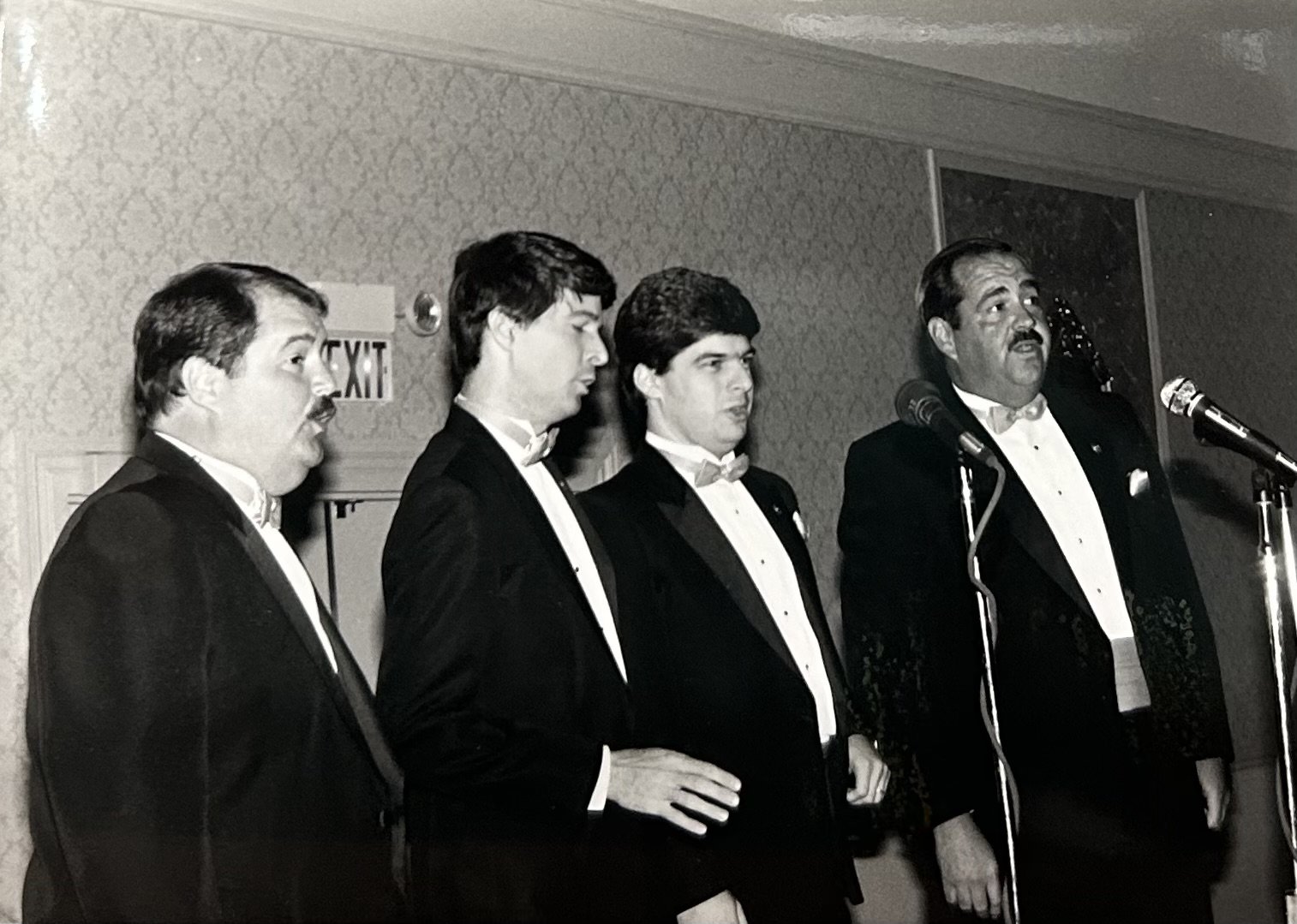
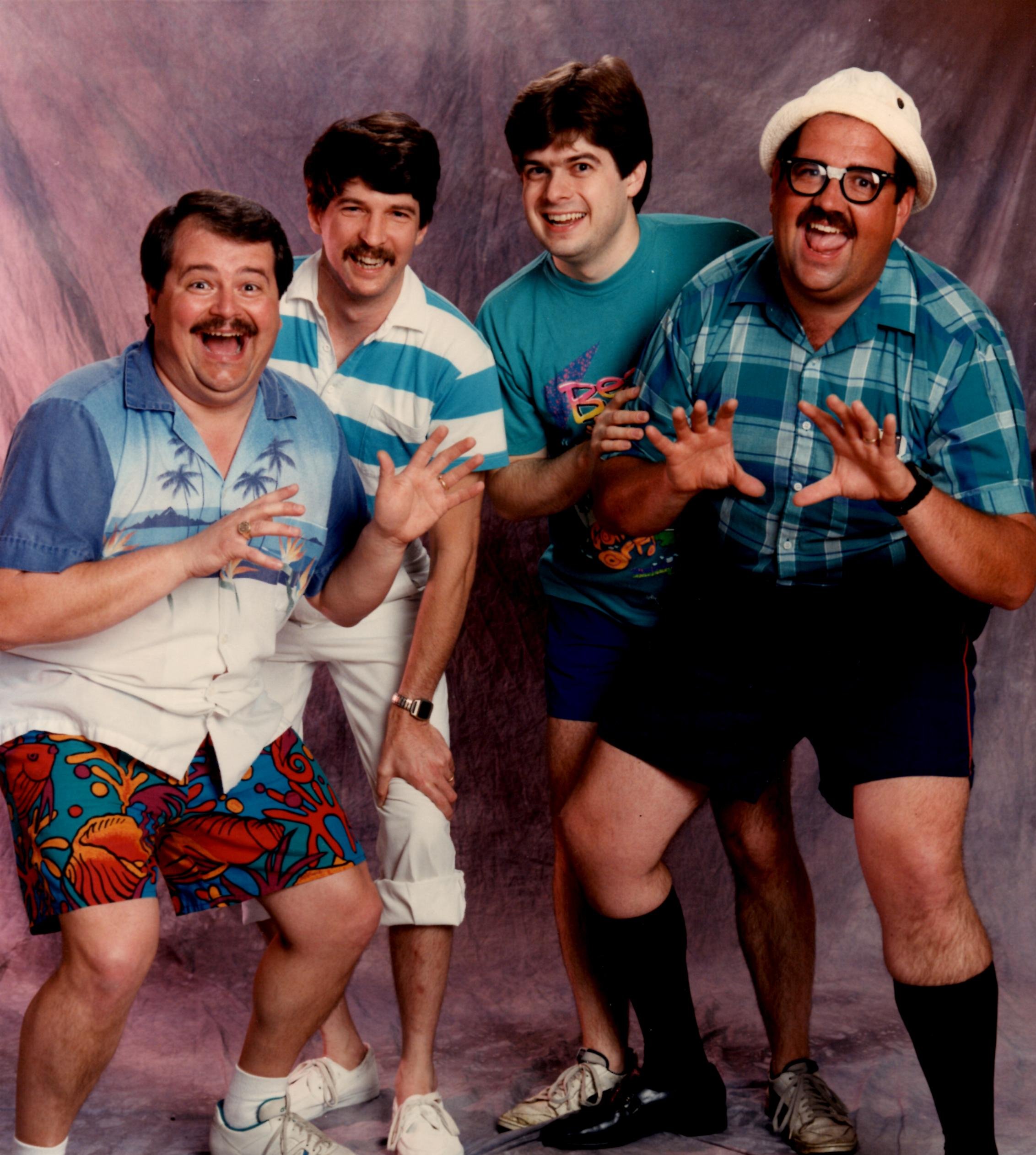
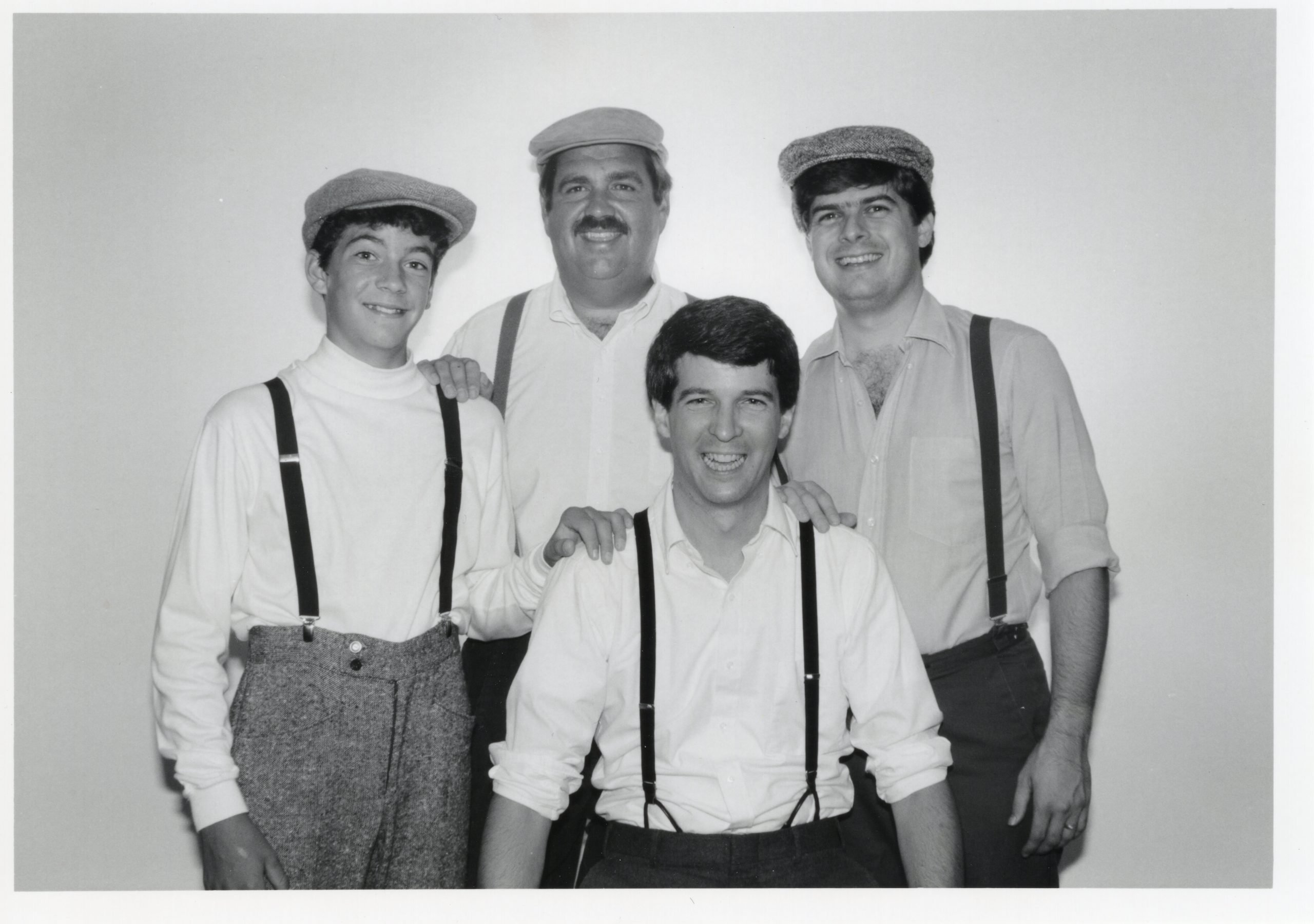
In this issue, we highlight a quartet of young men who were just getting their start in barbershop harmony.  Calling themselves Second Generation, the group was made up of  Rob Tigelaar (tenor), Jim Deegan (lead), Don Deegan (bari & Jim’s brother), and Scott Diehl (bass).   The group sang together in high school under choir director Bill Chapman, a former director of the Southwest Suburban (later Oaklawn) Chapter.  Don, Rob, and Scott graduated high school in 1980, while Jim graduated one year earlier.  The group reunited in 1981 when Bill’s wife Sue asked the boys to perform at his retirement party.  The boys entered the fall district contest that boasted an impressive lineup of 37 total quartets!  The group finished in the middle of the pack, placing 21st.   This was to be the one and only time the group competed.

Though only together for a short time, two of the boys – Don and Scott, went on to pursue other quartets and eventually became two-time district champs together with Debut (1989) and Off the Record (2009).

Phase IV (1975)

The group known as Phase IV was together for a couple of years in the mid-1970s.  Representing the Bloomington, Ottawa, and Sterling- Rock Falls chapters, the members included Ralph Johnson (tenor), Bob Park (lead), Richard Johnson (bari), and Ray Wahl (bass).  Bob Park was a past district champion with The Four Barons in 1960 (See FTV Spring 2021 Issue)  The group competed in the fall of 1974, not making the finals.  However, one year later, the quartet jumped up to 6th place.  Their rendition of “Cinderella” was a crowd favorite and is offered here now for your enjoyment.

Next Issue: Coming Winter 2026

Stay "tuned!"

WELCOME TO YOUR NEW DISTRICT WEBSITE!

We’re excited for you to be here! Much of the data on this site is pulled directly from the BHS database. If you see something that is incorrect, please let us know! You’ll find this button:

at the bottom of every page on the site. Just click it to report any errors you find! 

Once you click the X on this pop-up, you shouldn’t continue seeing it every time you visit the site!