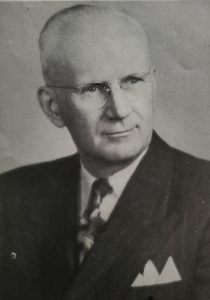
John Hanson was born in Peoria, Illinois on June 24, 1895, and as a young man became interested in harmony singing. Early in life he went into vaudeville. As a showman and singer, he loved the stage and loved putting together shows. He produced and directed minstrel and variety shows throughout the 1920‘s and 30’s. John also loved singing close harmony in a barbershop quartet.
One of John’s first quartets was called the Templeton Quartet and included his pal Jim Jordan (later to become the famous radio personality, Fibber McGee) on tenor, Bob McConnell on lead, Ed Ellig, baritone and John singing the bass. When they weren’t singing at church and community functions, they could be found on the street corner outside of Duffner’s Soda Fountain or Tompkin’s Saloon, singing their harmonies as long as somebody let them stay.
In 1917, John was called to the Army and served with the 90th Division A.E.F. in World War I, where he was sent to the front lines in France and Germany. The first part of his tour of duty was spent on the battlefield and the last part was spent with the 358th Headquarters Company putting on shows and entertaining the troops in France. After the war and back into vaudeville, John married his piano accompanist, Edith Greene. They had one child, a daughter named Betty.
Around 1934, John and his singing buddies from the small towns around Peoria formed the “Klose Harmony Klub.” In 1940, they learned about a new organization singing “barbershop” harmony and quickly signed up, forming the Peoria chapter of S.P.E.B.S.Q.S.A. with 54 members.
Subsequently, the Peoria chapter began sponsoring other chapters around central Illinois and John ended up being their director at one time or another. Soon, John was directing chapters in Peoria, Bloomington, Decatur, and Canton. He taught each chorus the same songs, all by rote, so there was no written music involved.
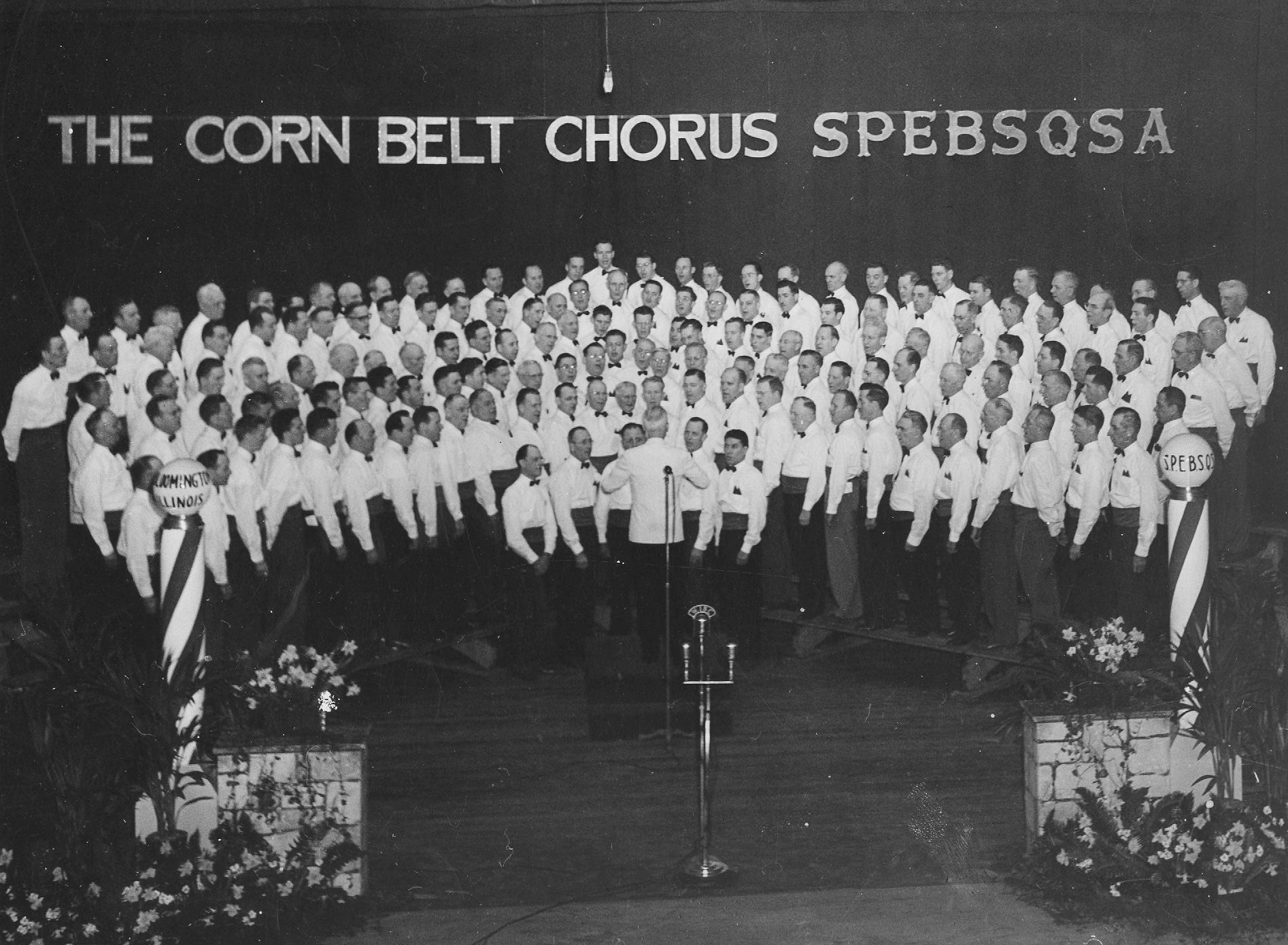
Because John’s skills as a director were reaching so many men in different chapters around the central part of Illinois, it was only natural that something historic would happen…and it did just that. About 30 of John’s central Illinois chapter members gathered on the balcony over the lobby of the Pantlind Hotel in Grand Rapids, Michigan at the 1942 national convention and decided to join in song. With John as their director, they just happened to all sing the same songs. After the first number they received a big round of applause and someone from the lobby called up…“what’s the name of this bunch?” John Hanson turned to Joe Bunting of Bloomington and asked, “what’ll we call ourselves?” Bunting, on the spur of the moment, shot back, “the Corn Belt Chorus.” And Hanson, a master showman, announced that this was, indeed, the great Corn Belt Chorus from central Illinois. The group was asked to sing at the contest finals that night and it is believed to be the first chorus ever to sing at a national convention.
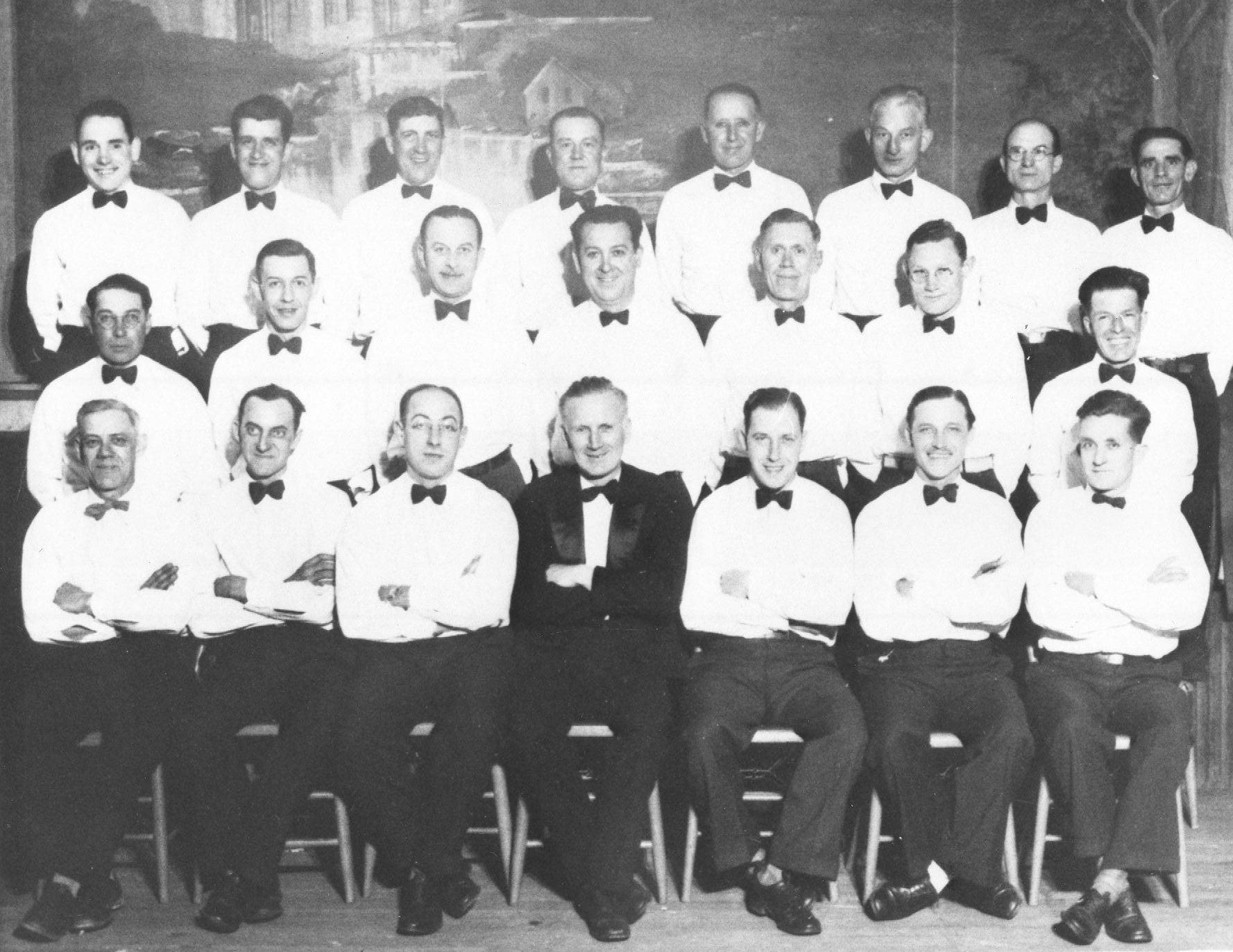
Over the following year, the group became more organized. Whenever one of the member chapters had a show, the other choruses would converge on that city and join the chorus, which sometimes swelled over the 200 mark. Shows then were held on Sunday afternoons and there was always a big afterglow following. This afforded some of the best interchapter relations imaginable. The chorus uniform was simply a white shirt and black bow tie, with dark trousers and shoes.
Some 15 cities were in the organization at one time or another. They included Canton, Champaign, Charleston, Decatur, Galesburg, Jacksonville, Mattoon, Monmouth, Princeton, Dwight, Springfield, Peoria, Gibson City, and Lincoln. The chorus sang for at least two years as the windup attraction at the Illinois State Fair with Earl Bach and Joe Bunting serving as masters of ceremonies. Perhaps the Corn Belt Chorus reached its zenith at the Fair in 1946 when some 250 singers crowded onto the stage for a concert before thousands of fairgoers.
Despite his reputation as an outstanding director, John also loved singing in a quartet. In 1941, he sang briefly with Glenn Howard in the Capitol City Four from Springfield, placing 5th at the national contest in St. Louis. Most of his quartet years, though, were spent singing with The Gipps-Amberlin 4, named after a well-known Midwest brewery located in Peoria. The group was made up of Hanson singing bass, along with Bob Place on tenor, Mort Wrigley on baritone, and LaVerne Blew on lead. It was at the 1944 Detroit contest that the quartet literally stopped the show with their rendition of “Shine” when the audience demanded an extra bow before the contest could continue. This was the first and only time this ever took place. That year, the group took home a fourth place medal.
John’s influence in the barbershop world didn’t stop with his quartet singing and chorus directing. In 1942, he was named to a Society Board Member position and in 1943, became the Society’s first Master of Ceremonies at the convention held in Chicago that year. It was at this convention that he presented his 150-voice Corn Belt Chorus to the audience, thus planting a seed that would result in chorus contests a few years later.
John Hanson passed away in July of 1954 and left a long and illustrious legacy of barbershop harmony not only throughout central Illinois, but for the District and Society as a whole.
Contributions to this article made by: Betty Hanson Oliver, L. Earl Bach, Charlie Driver, and David Wright.