From The Vault:

Volume 4 Number 4 – Fall 2024

A NOTE FROM YOUR DISTRICT HISTORIAN

Greetings friends of the Illinois District!

I decided to do something a little different for this issue.  As Veterans Day is nearly upon us, I thought it appropriate to highlight those who served in the armed services, as well as those who supported the war effort through their talents as barbershop singers.  So, this newsletter is a “thematic” one, as we salute our veterans.

In this issue, you’ll learn about the various USO tours that some of our more famous district quartets made overseas to entertain troops during the Korean and Vietnam Wars.  Included is a rare recording of a Four Renegades song from their 1969 USO tour!   We also spotlight QCA quartet members who have performed military sets in their competition packages, remember a time when barbershop concerts helped support the war effort during World War II, and feature two special young quartets made up of servicemen who earned international medals in the 1950s.  Finally, we round out this issue with a special “retro” recording of Northbrook’s famous soldier package from 2001.

Kudos goes to historical committee member Jim Stahly, who guest authored the article on USO barbershop shows – thank you Jim!  I hope this issue brings about greater appreciation for those who have served this country and those that have supported them through their music over the years.  We honor all of you!!

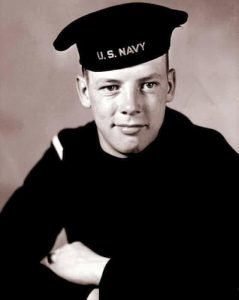
Finally, on a personal “note”, I’d like to dedicate this issue to a man who not only served his country, but the Illinois District with great distinction.  Ray Henders, tenor extraordinaire, passed away on August 29, 2024.  He served with the U.S. Navy during the Second World War and was a 70+ year member of the Barbershop Harmony Society.  He sang in numerous district quartets, including the 1971 District Champs, Soundtracks, as well as 1979 District Champs, Chicago News, which won the International gold in 1981.  Ray’s devotion to his country and hobby was unmatched, and he definitely belonged to the “greatest generation.”  May he rest in peace.
USO Shows & Barbershop Harmony

This article was contributed to by Mr. Jim Stahly.

The USO (United Service Organization) was founded in 1941 to keep military service members “connected to family, home, and country.”  During World War II, this nonprofit corporation sought to be the GI’s “home away from home.”  Disbanded in 1947, the USO was revived for the Korean War and it still provides live entertainment to members of the armed forces and their families in more than 200 locations.

Special Services, created in 1940 by the War Department, was the entertainment branch of the American military. It not only used its own troops as talent, but also engaged local performers. Quartets representing the Barbershop Harmony Society were among the groups that took entertainment to U.S. military members across the world. They were recruited by Special Services and donated their time and talents to sing for GI’s at installations in Europe, Asia and the South Pacific.  The performers’ time and talents were donated, but all expenses (travel, lodging, food) were covered.  These performances were especially popular during the 1950s and 1960s during the Korean/ Vietnam Wars.

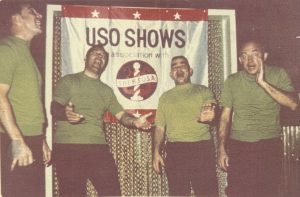
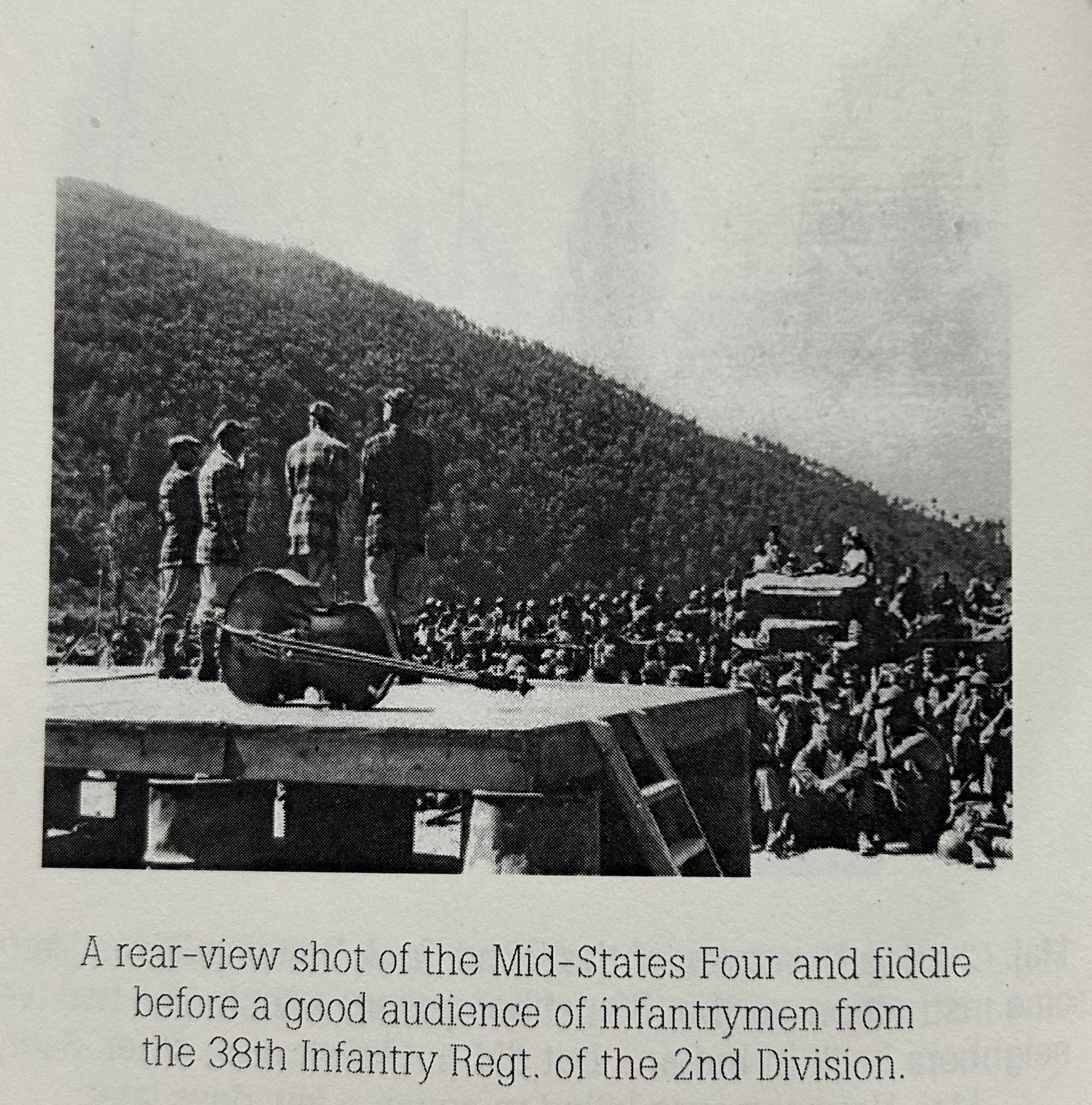
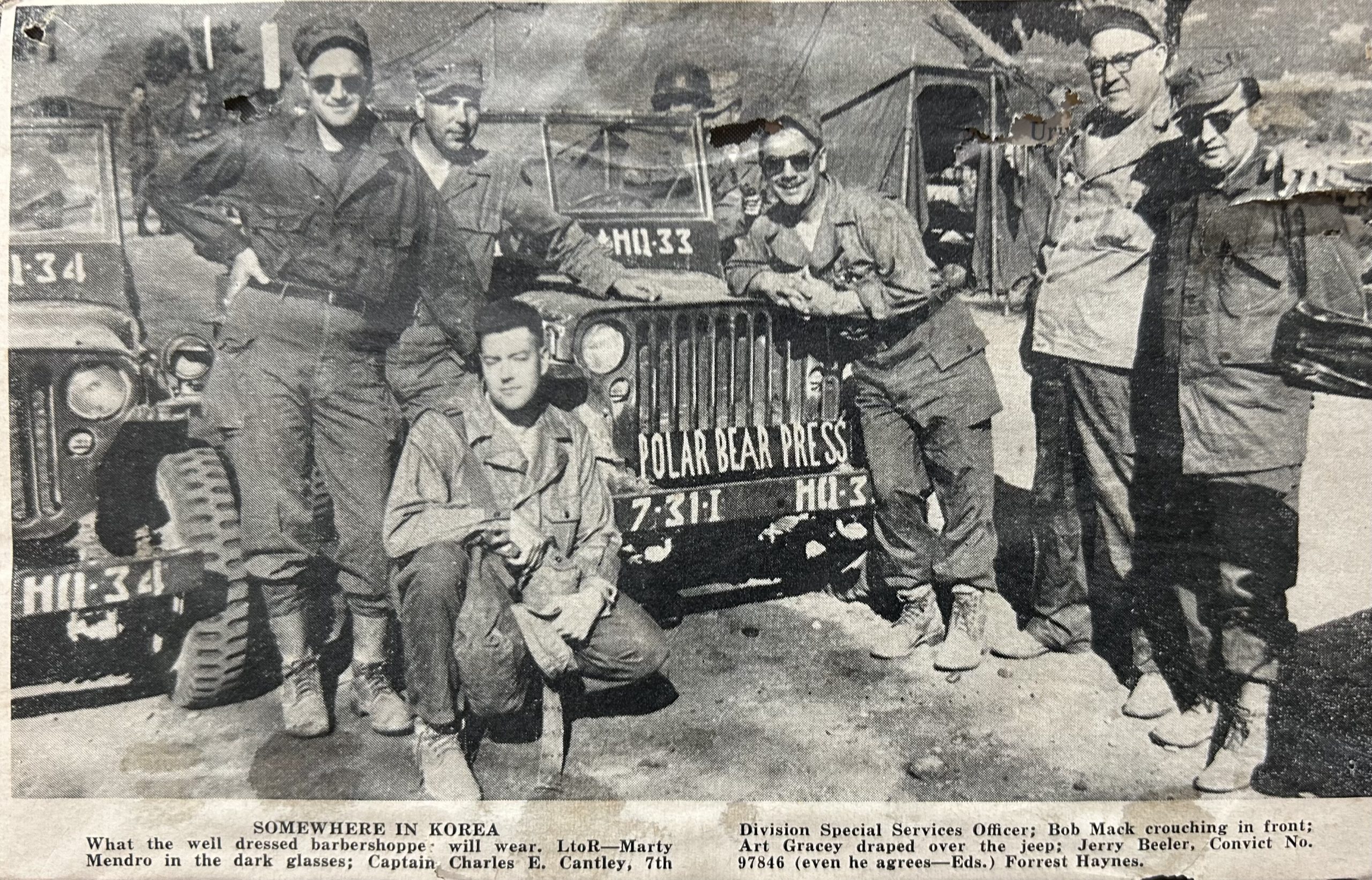
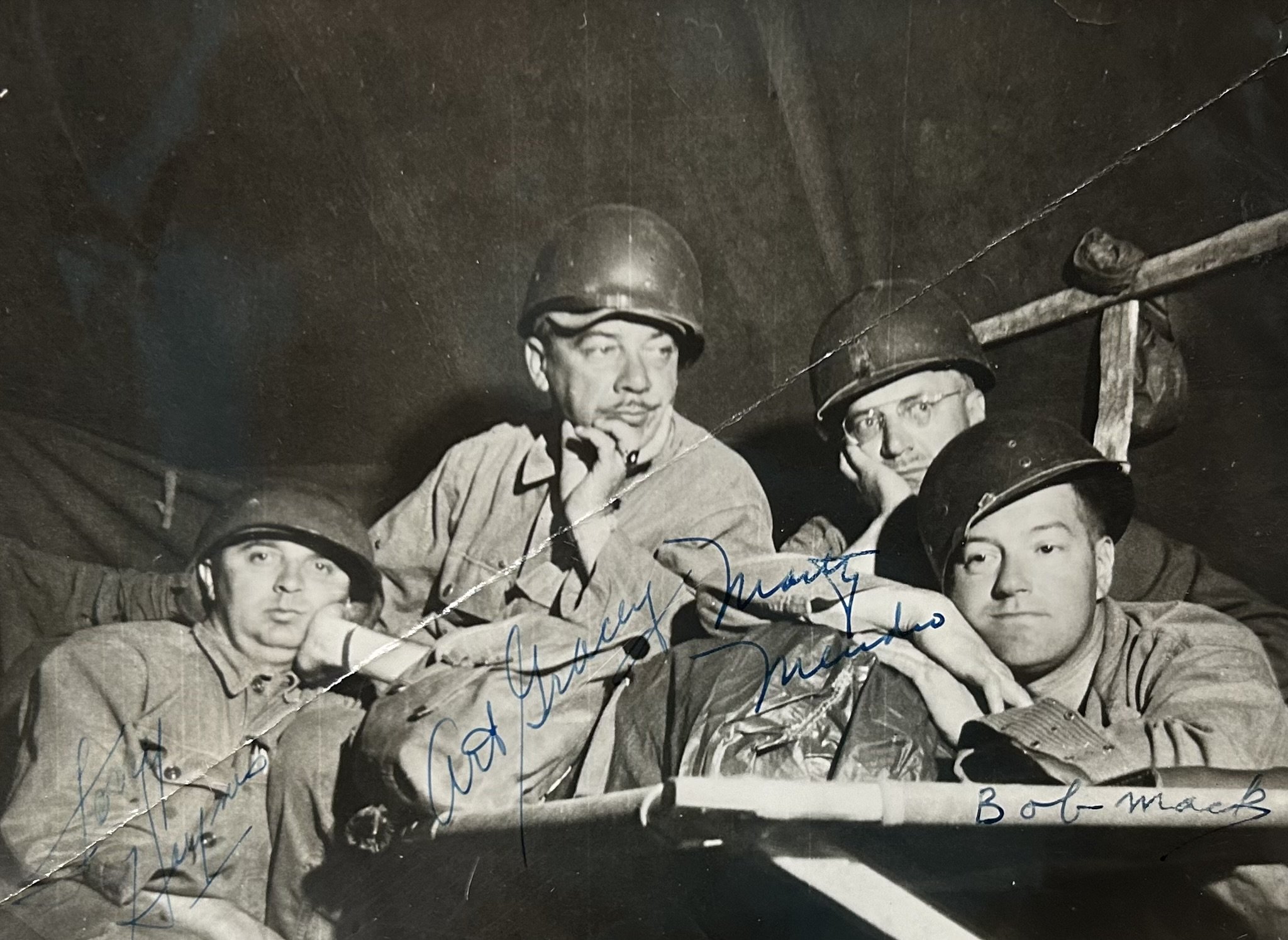
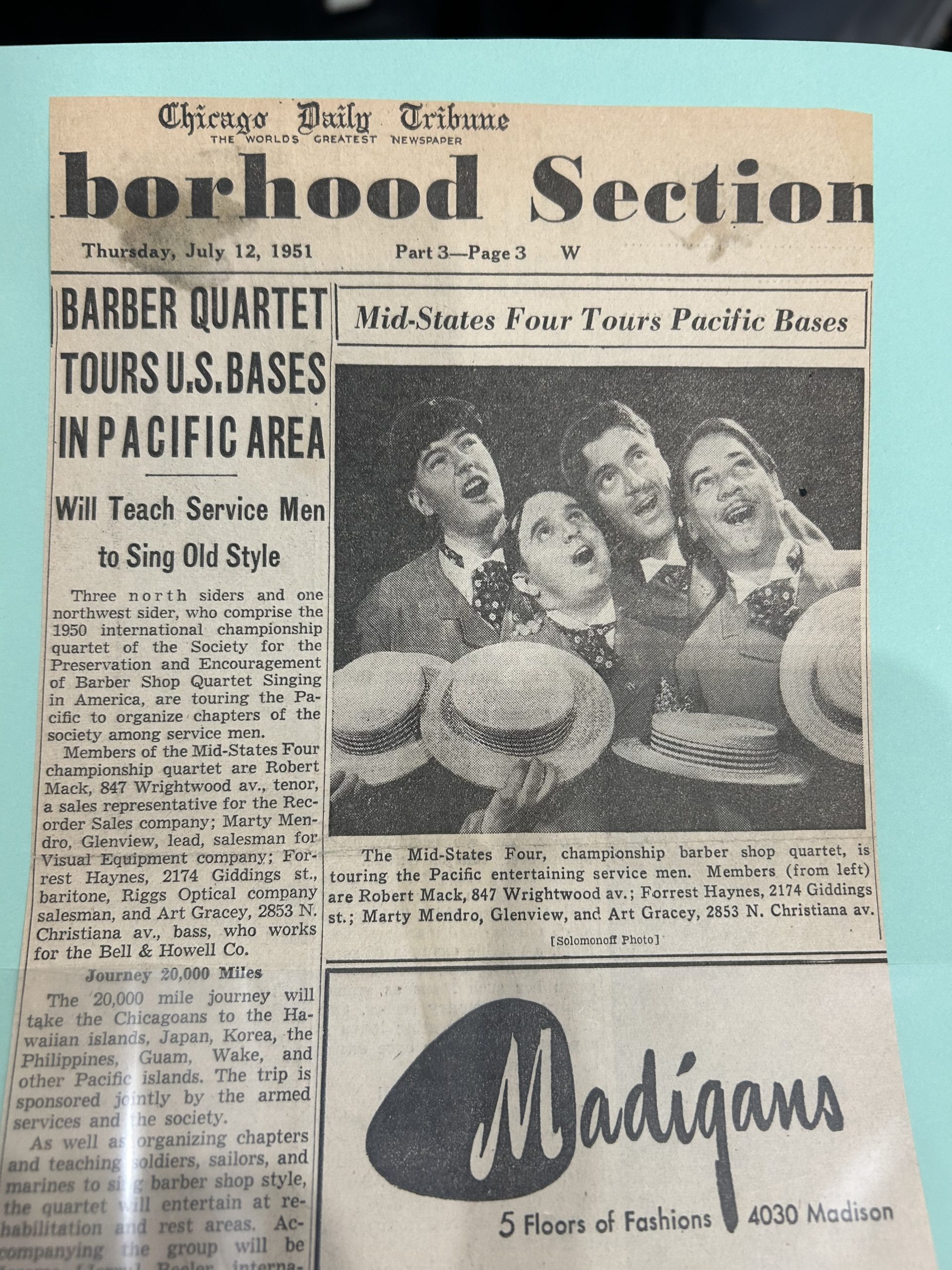
Several Illinois-based barbershop quartets shared their four-part harmony and showmanship with members of all branches.  The 1949 International Champs, The Mid-States Four (Bob Mack, Marty Mendro, Forry Haynes, and Art Gracey) were among the first, traveling to Korea in 1951 just two years after winning their international gold to entertain troops during the Korean War.  Known as “Operation Harmony”, the tour was preserved via a day-by-day journal kept by the group that was later bound and published by the Society as a model for quartet generosity and hospitality during times of war.

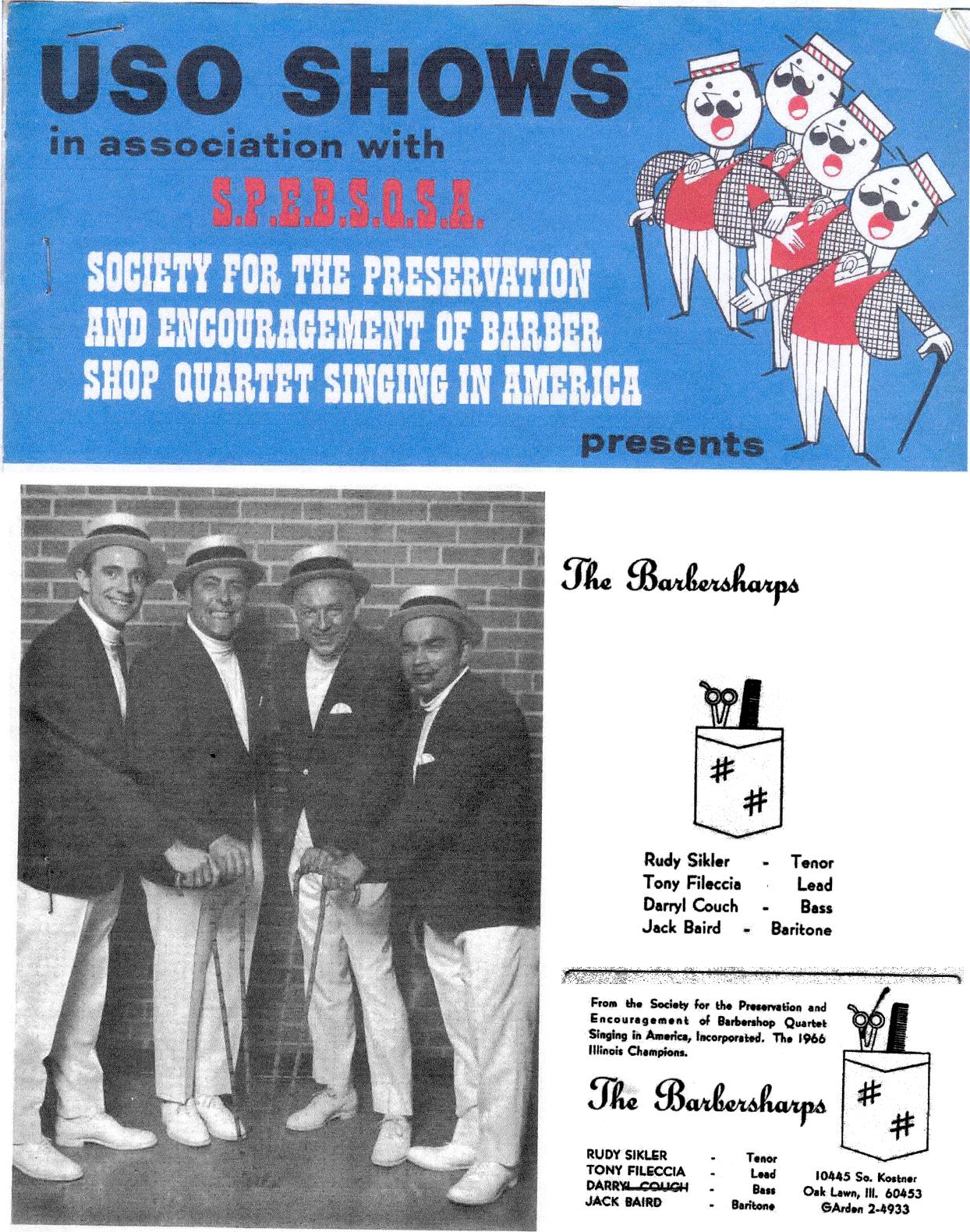
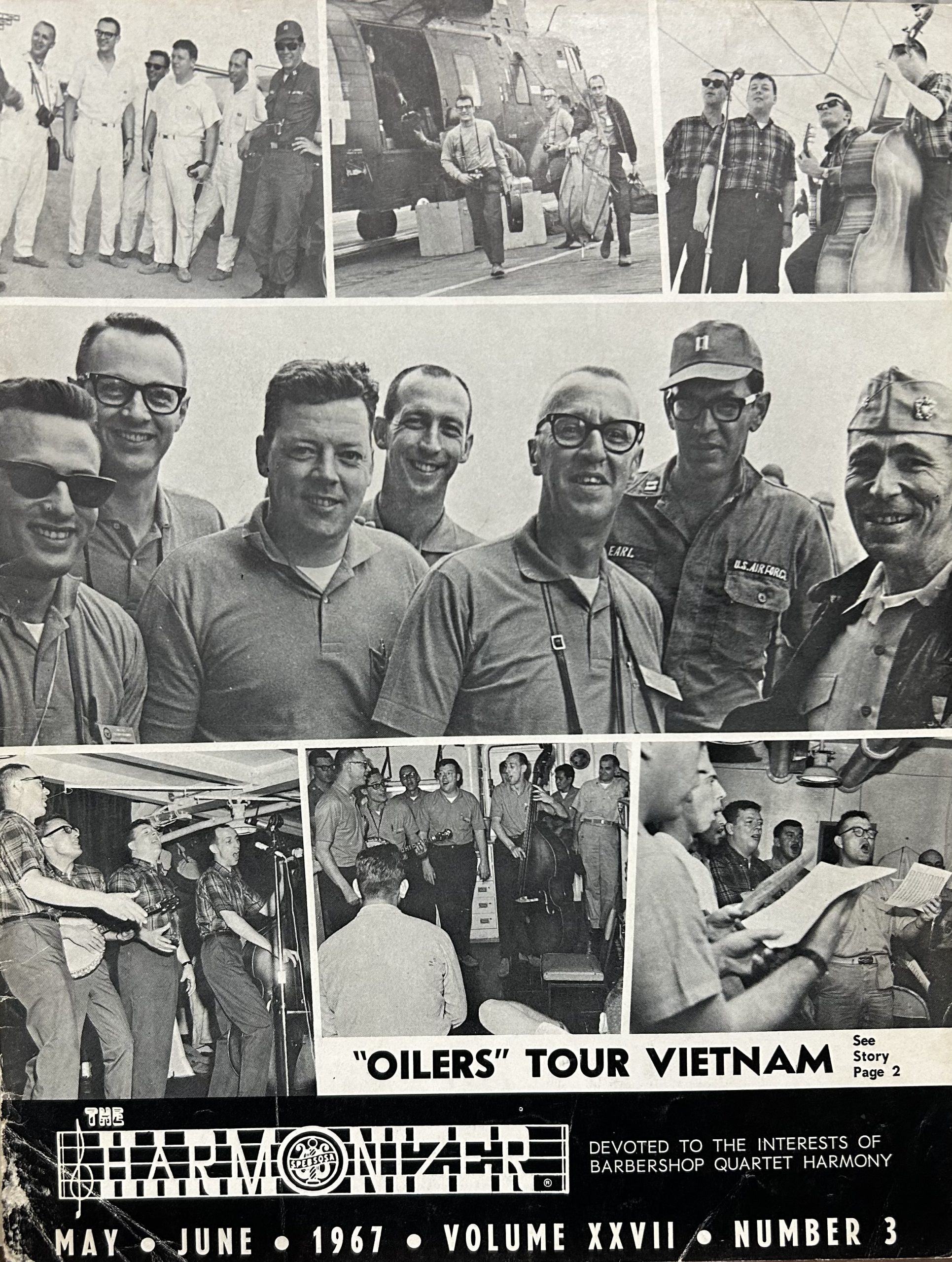
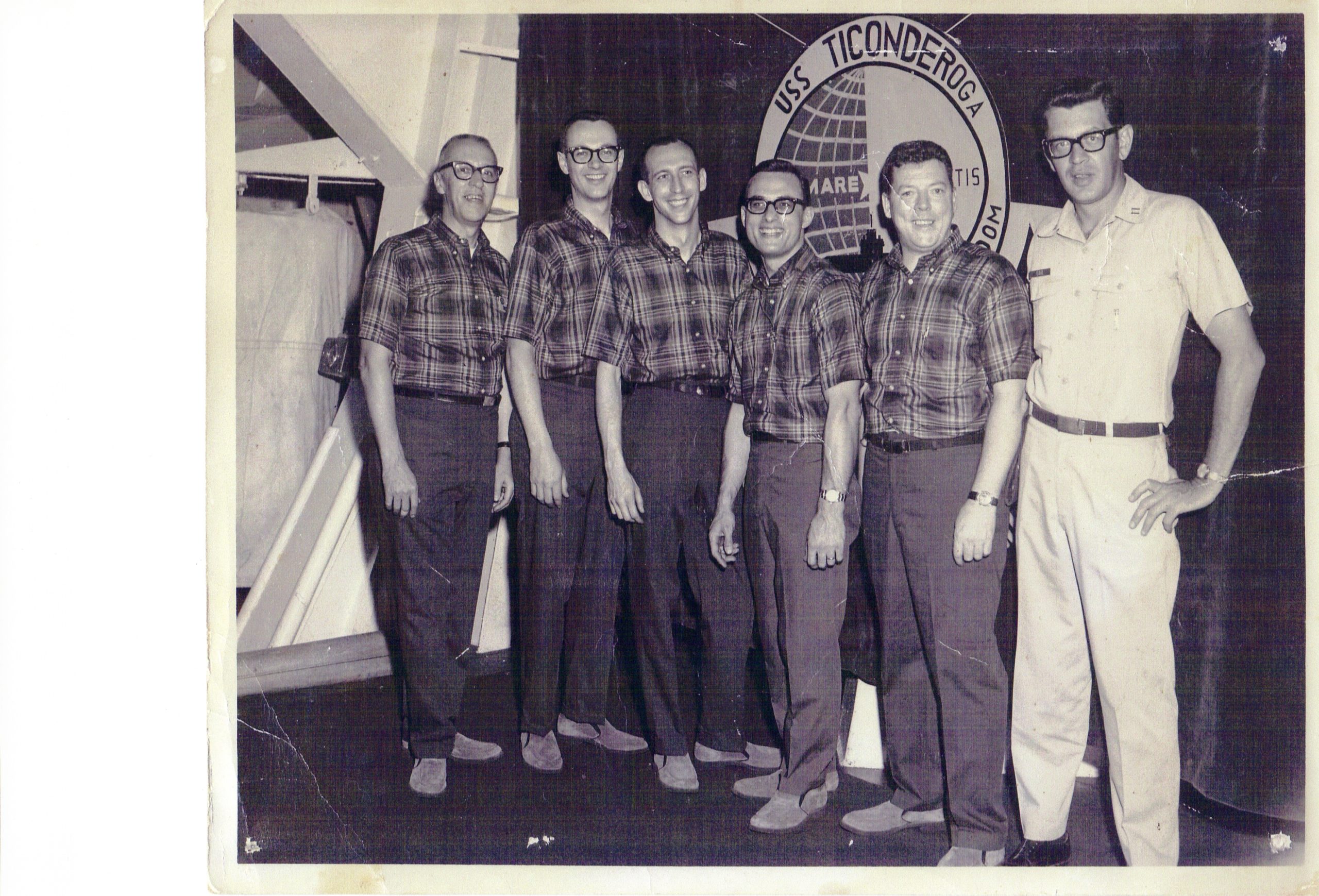
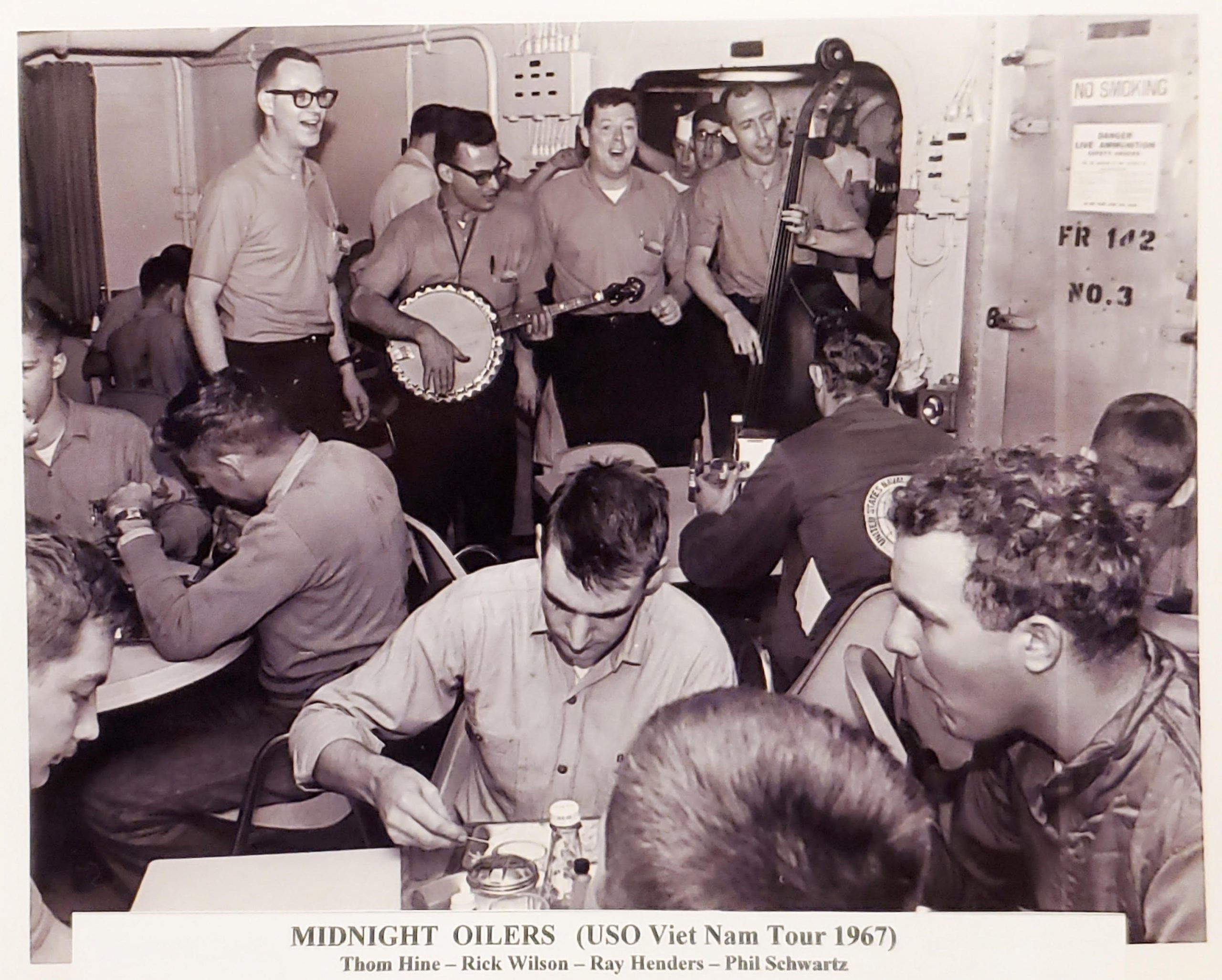
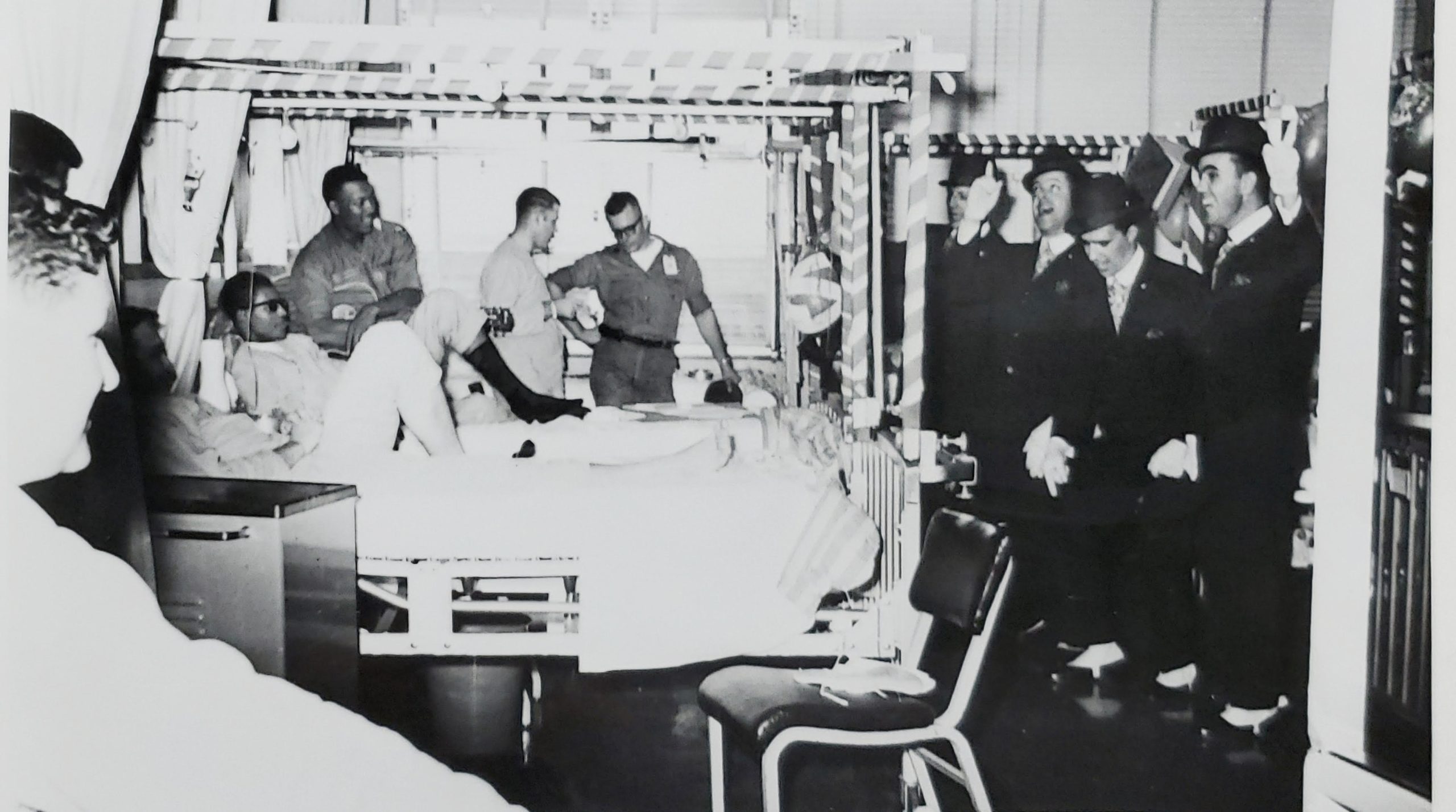
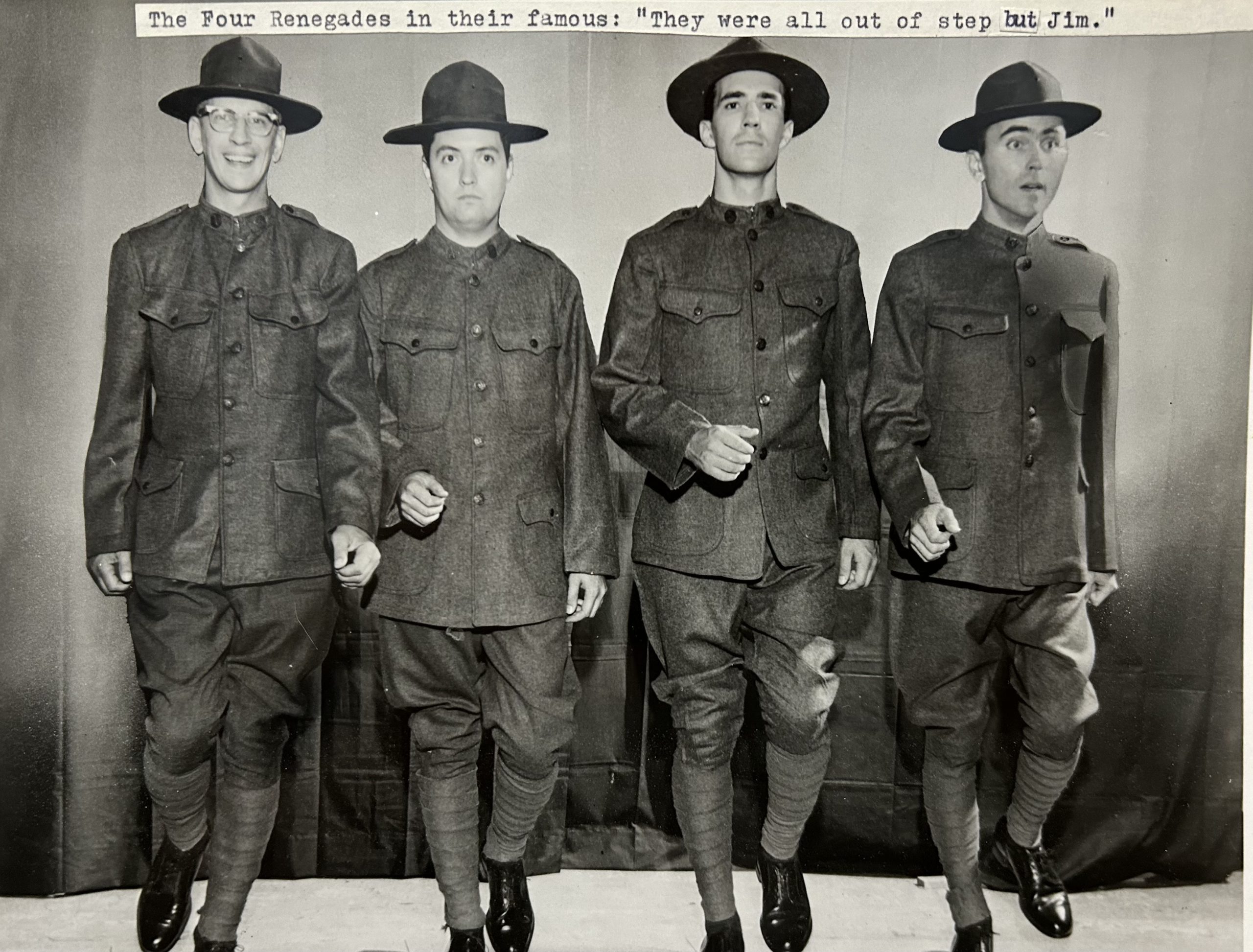
A little later, in the mid-late 1960s, groups like The Four Renegades (Warren “Buzz” Haeger, Ben Williams, Jim Foley, and Tom Felgen) traveled on the USO circuit, as did The Barbersharps (Rudy Sikler, Tony Fileccia, Jack Baird, Darryl Couch) and The Midnight Oilers (Ray Henders, Rick Wilson, Phil Schwarz, and Thom Hine).   The Oilers trip to Vietnam was documented in the May/June, 1967 issue of Society publication, The Harmonizer.  

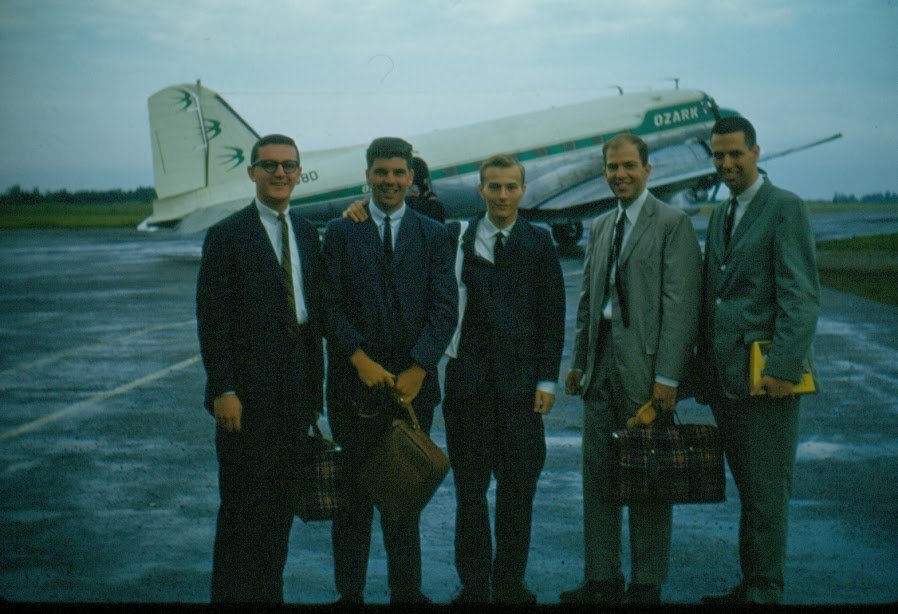
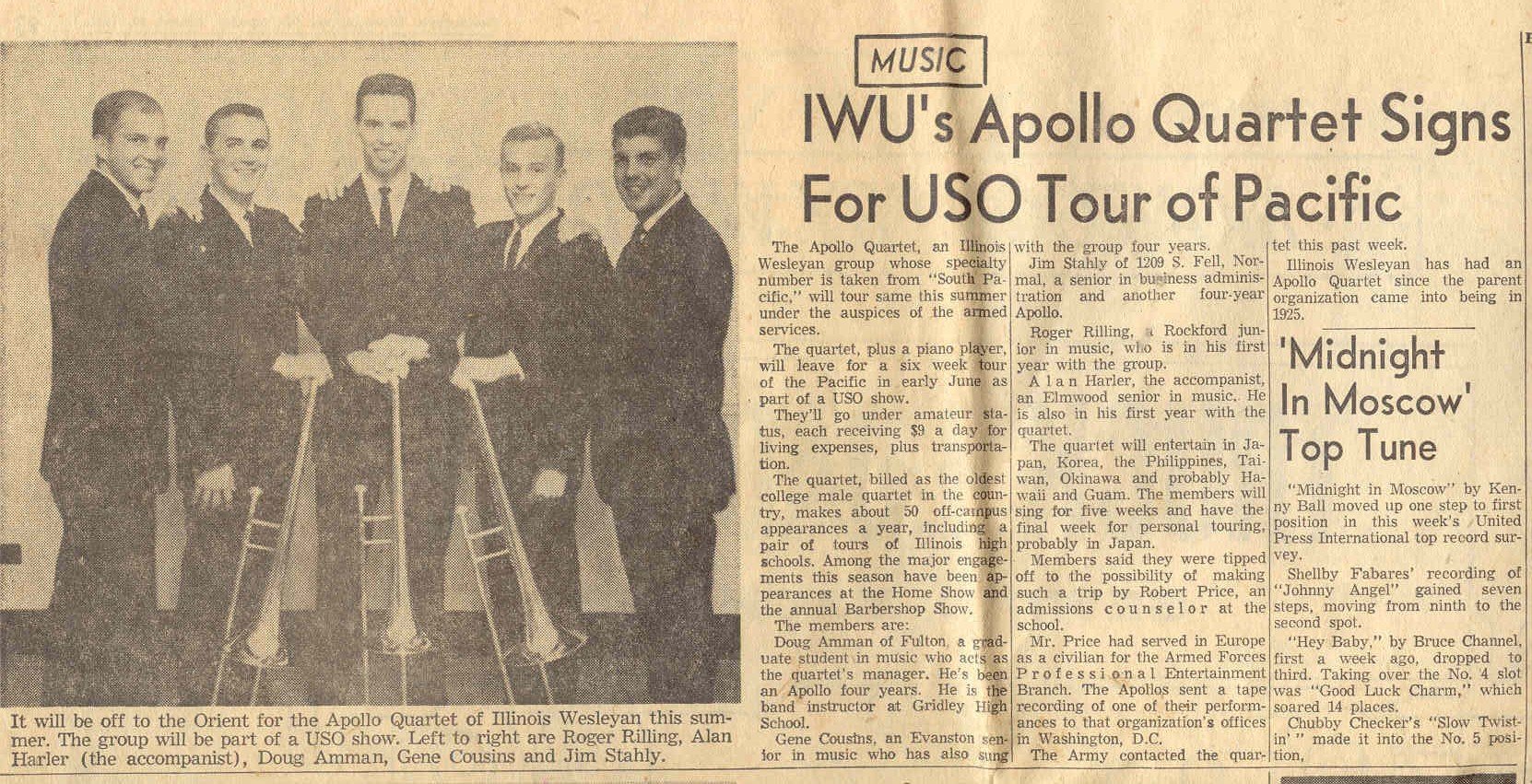
Jim Stahly (tenor of the 1970 Illinois District Champs, The Ideals), also had an experience performing overseas, when his college group, The Apollo Quartet from Illinois Wesleyan University, traveled to Southeast Asia to entertain troops there from June-July, 1962.   “Even as a 22-year-old, I knew I was going on a once-in-a-lifetime experience,” Stahly recalls.   “As a small group, we got to small installations that were starved for attention, so we were treated like stars!  Then, the week before we came home, we were at an island base where we witnessed an A-bomb test!”  

These quartets not only brought the joy of barbershop harmony to our troops, but lifted the spirits of those who served during very tumultuous times in our nation’s history.


QCA Spotlight

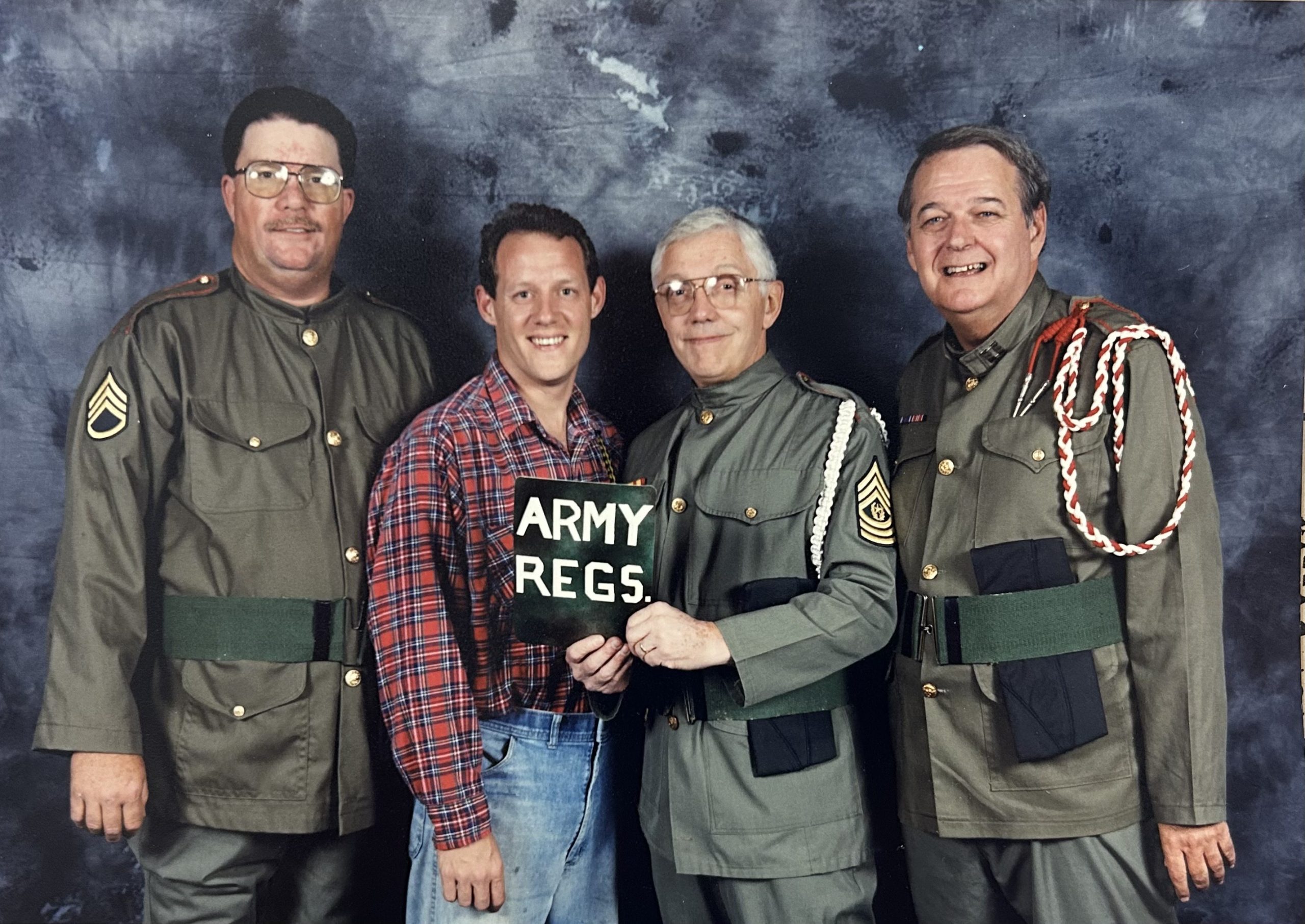
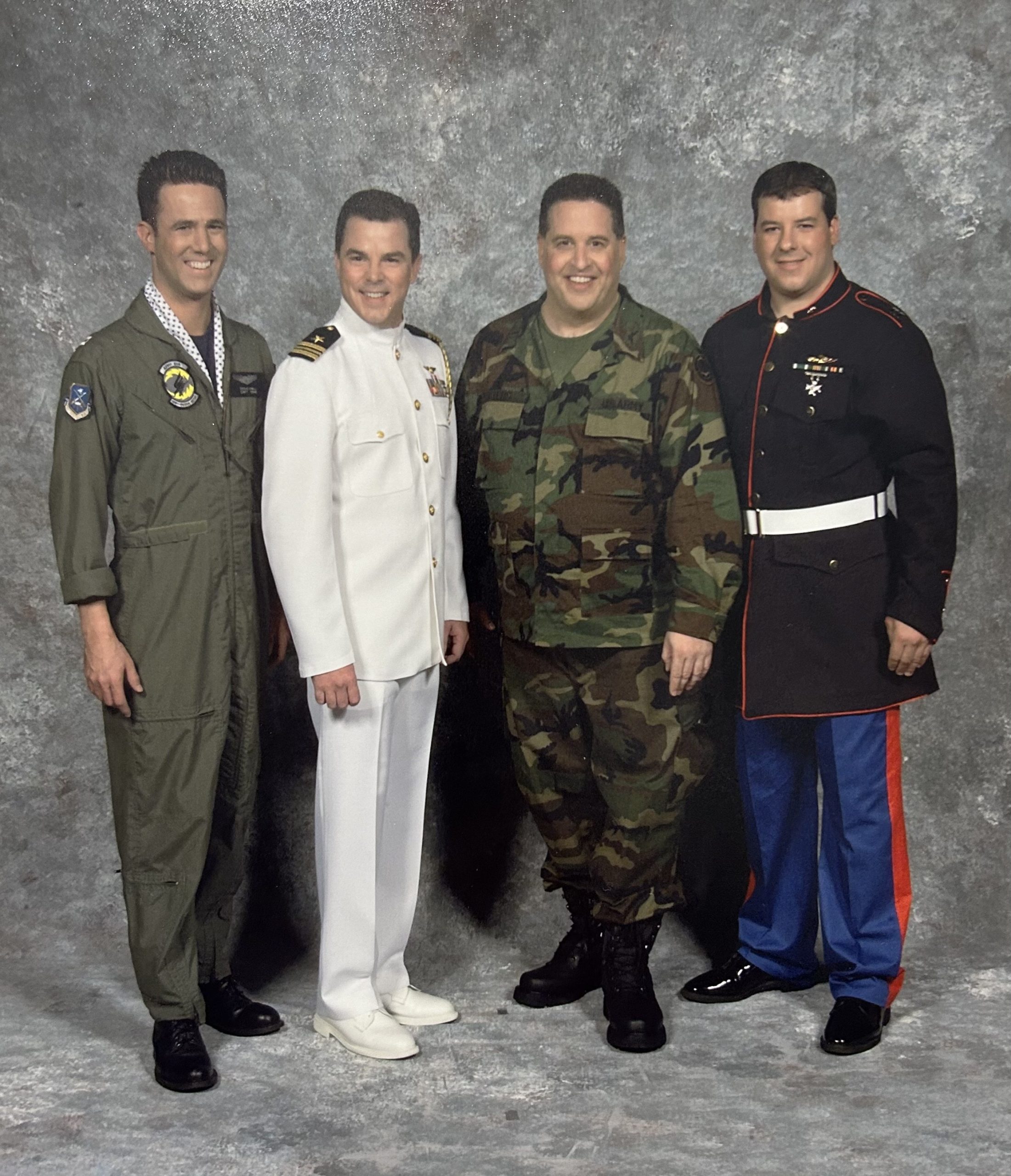
QCA Members that Have Honored Our Servicemen

Remember the Ladies Too!

During the Second World War, many women who did not stay behind to work in the factories (i.e. “Rosie the Riveters”) found fulfillment in enlisting in the armed forces.  At the time, women were not allowed to be combat soldiers, so they served in a different capacity.  The Women’s Auxiliary Corps (WAC) was created in 1942 and served as the women’s branch of the United States Army during World War II.  WAC members served in a variety of noncombat roles, including switchboard operators, mechanics, bakers, weather observers, cryptographers, and radio operators.

Just as there were men in the armed services who formed barbershop quartets to entertain troops, it is not surprising that women were doing the same.  The existence of female quartets in the early 1940s may have been a factor in the formation of Sweet Adelines International at the war’s end in 1945.

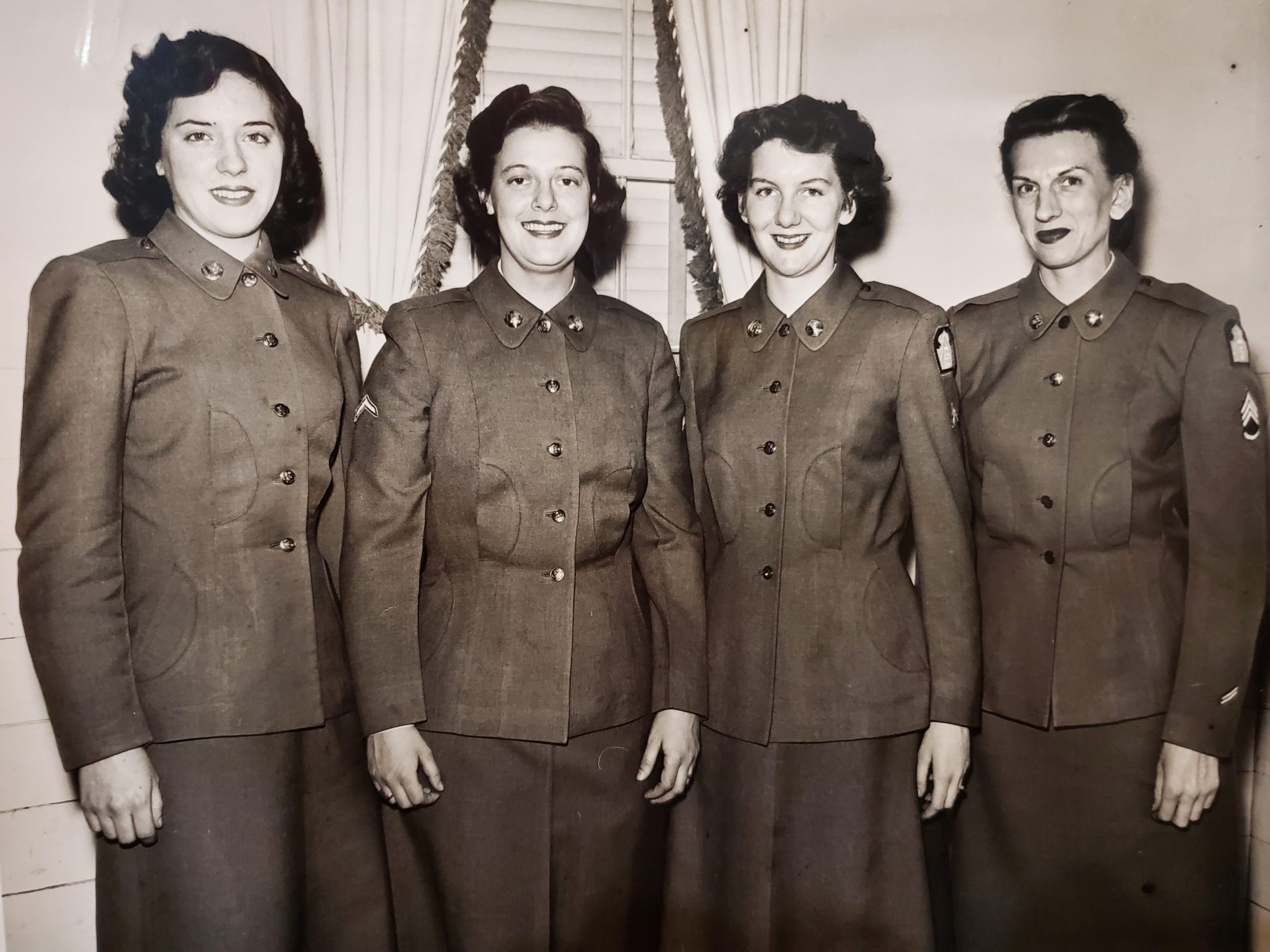
Within our archives is a photo of a female “WAC” barbershop quartet in uniform.  All four ladies were based at Fort Sheridan, Illinois.  Fort Sheridan is located on the North Shore of Lake Michigan, and was originally developed as a US Army installation in the late 1800s.  During World War II, Fort Sheridan became a recruitment center as well as the administrative control headquarters for prisoner of war camps in Illinois, Michigan and Wisconsin. The Fort was officially closed by the Army on May 28, 1993 and the area has been designated as a US historic landmark.

Not much is known about this quartet, however the names are listed on the back of the photo.  From L to R are Pvt. Donna Richendollar, PFC Doris V. Soden, PFC Gloria A. Clark, and SGT Isolde M.G. Zitzewitz.

"Singing for Victory!"

After the December 7th, 1941 attack on Pearl Harbor, America was committed to entering the Second World War.  As the country mobilized, President Franklin D. Roosevelt created the War Industries Board, which handled the re-organization of the nation’s manufacturing.  Factories that normally produced domestic goods now had the responsibility of ensuring troops had the weaponry needed to fight in both the European and Pacific Theaters.  Rationing became a normal, everyday sacrifice by Americans, and individuals were encouraged to buy war bonds to help finance the war effort.

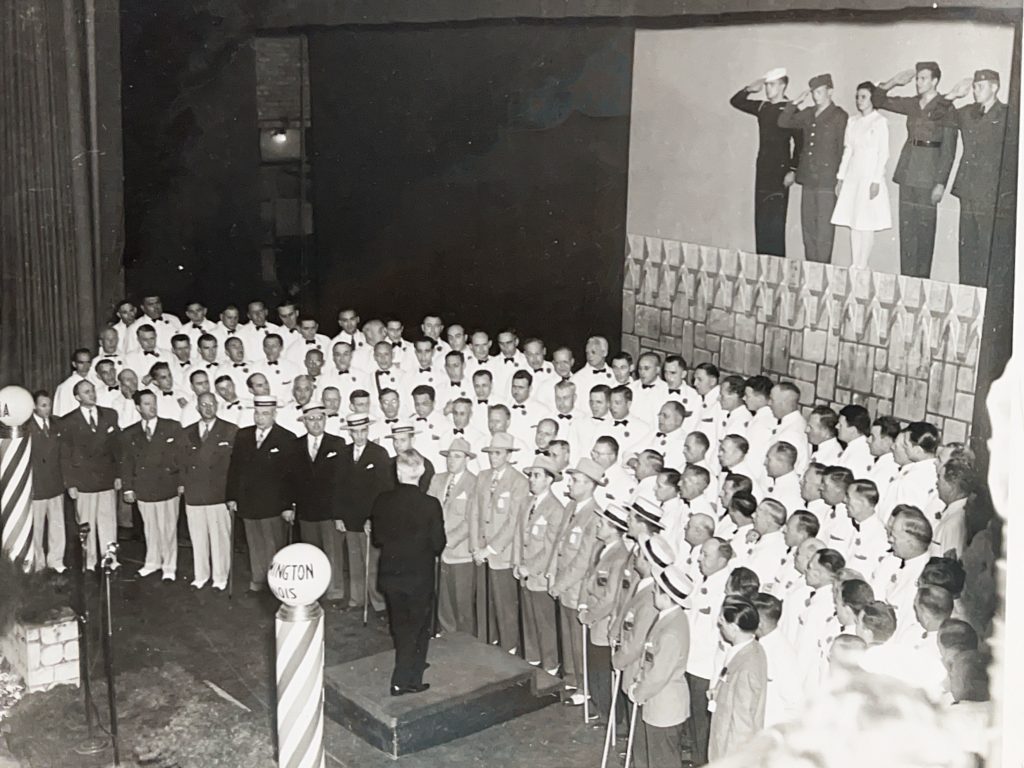
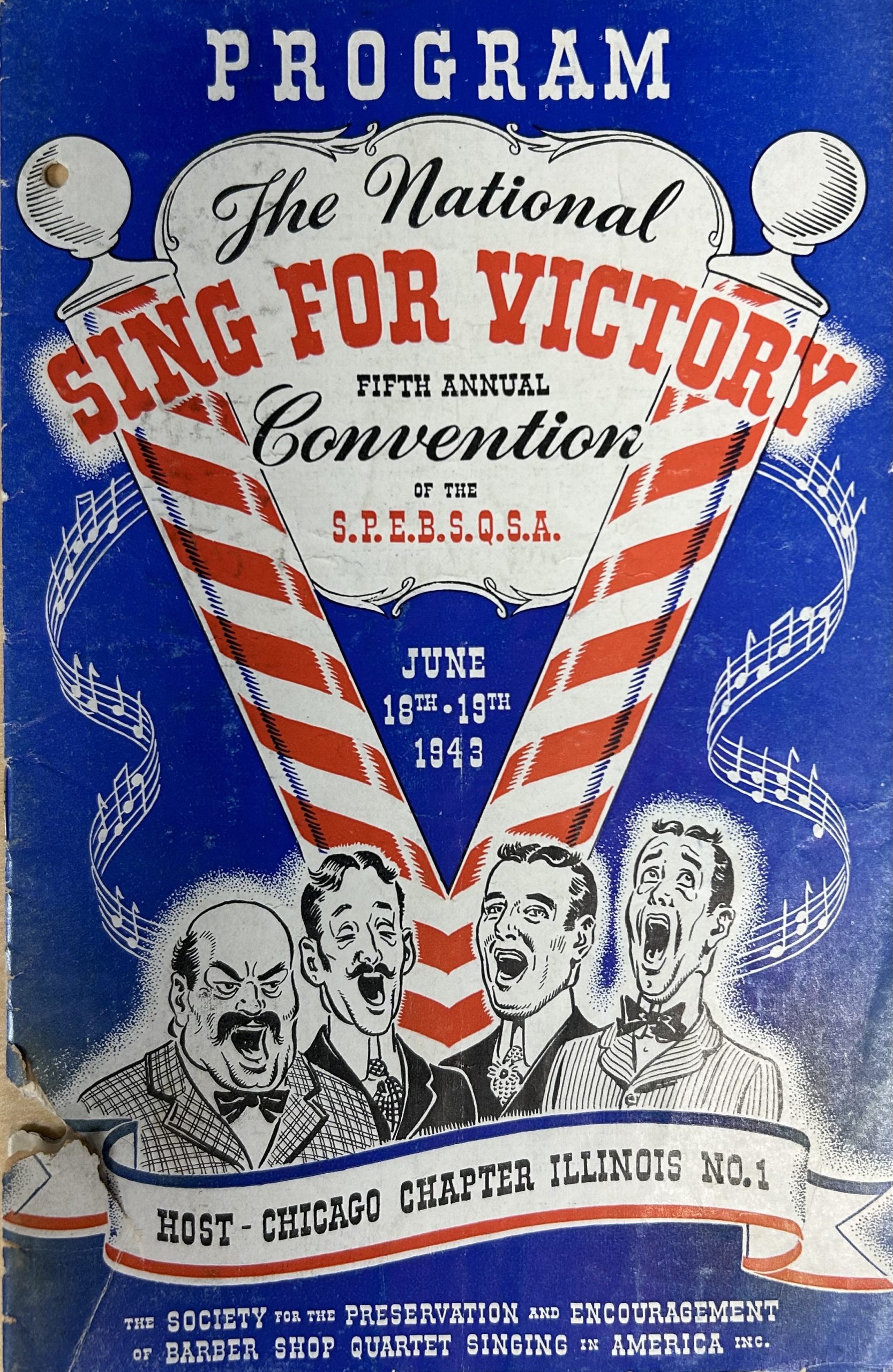
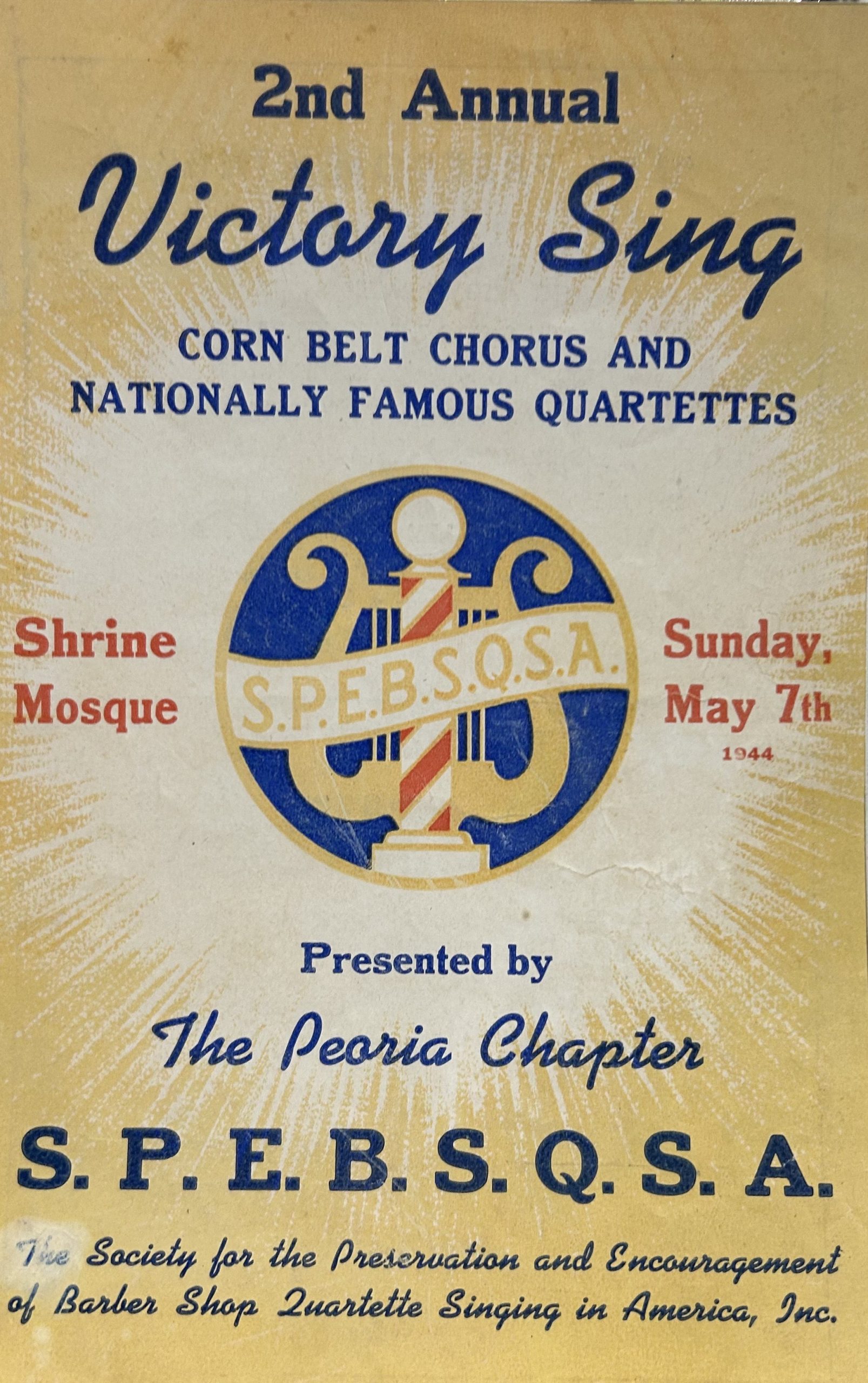
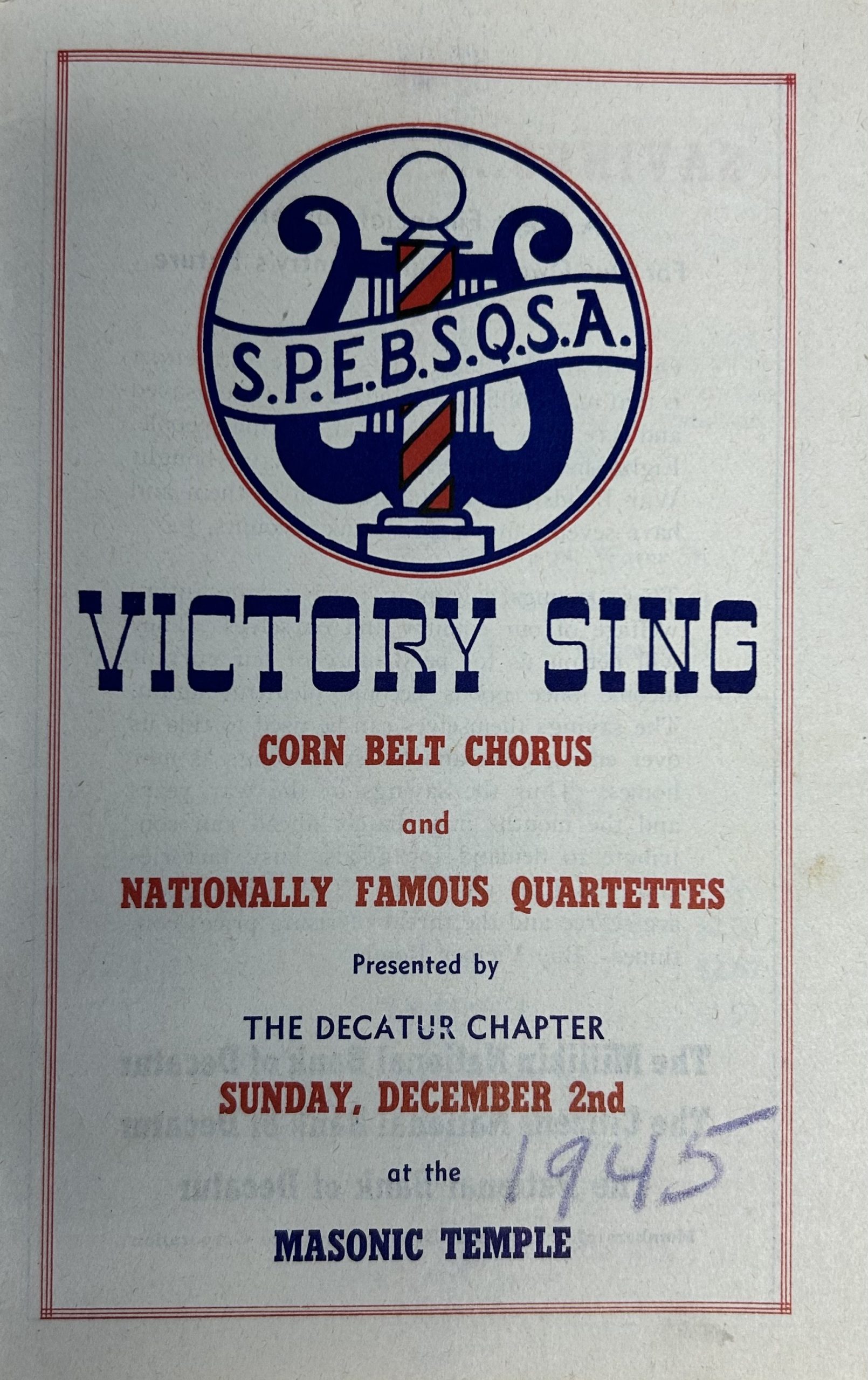
Among the more interesting aspects of the Home Front is a series of “Sing for Victory” concerts directed by John Hanson (see FTV – Summer ’22 Issue).  These concerts featured The Corn Belt Chorus (made up of barbershoppers from several communities, including Decatur, Peoria, Bloomington, Canton, Springfield, Jacksonsville, Champaign, and Danville) as well as a parade of chapter and district champion quartets.  These concerts were patriotic indeed, and honored our men and women in uniform while helping to raise money for the war effort.

In this issue, we feature various programs from those concerts held in the 1940s, including the cover of the 1943 International convention program, held in Chicago.

Military Medals - The Four Teens & The Air Fours

Information in this article was provided by the Barbershop Wiki Project.

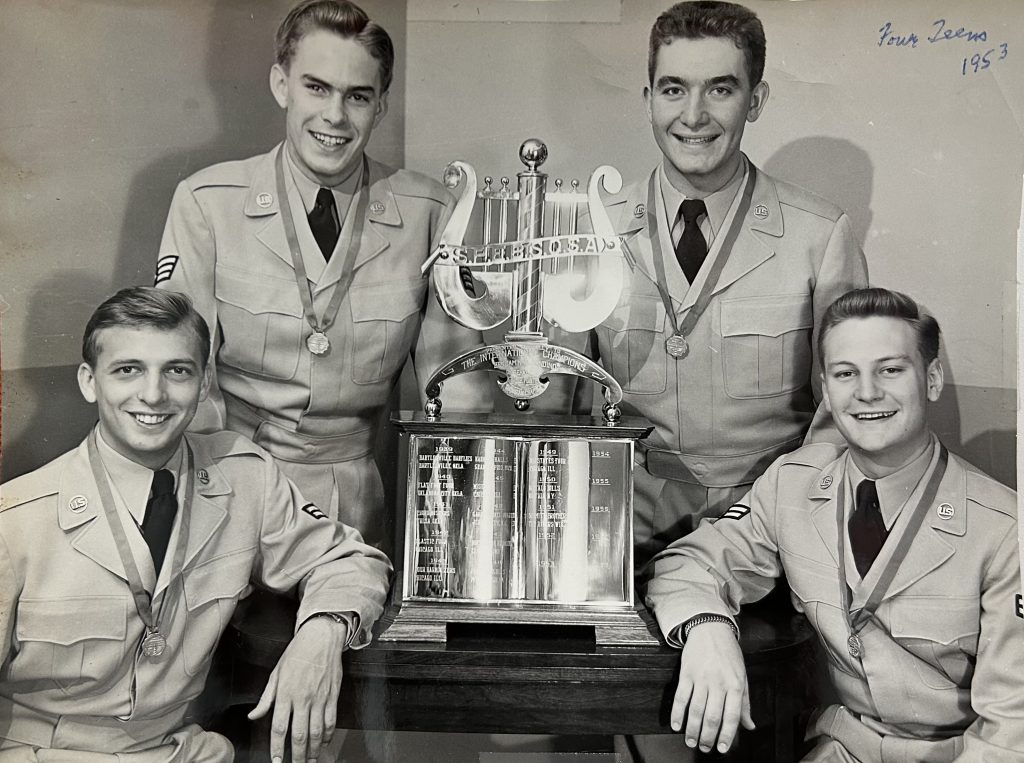
Twice during the 1950s (a time often referred to as the “golden age of barbershop”), the Barbershop Harmony Society actually witnessed men in uniform compete and medal at international contests.  Both quartets had ties to the Illinois District.

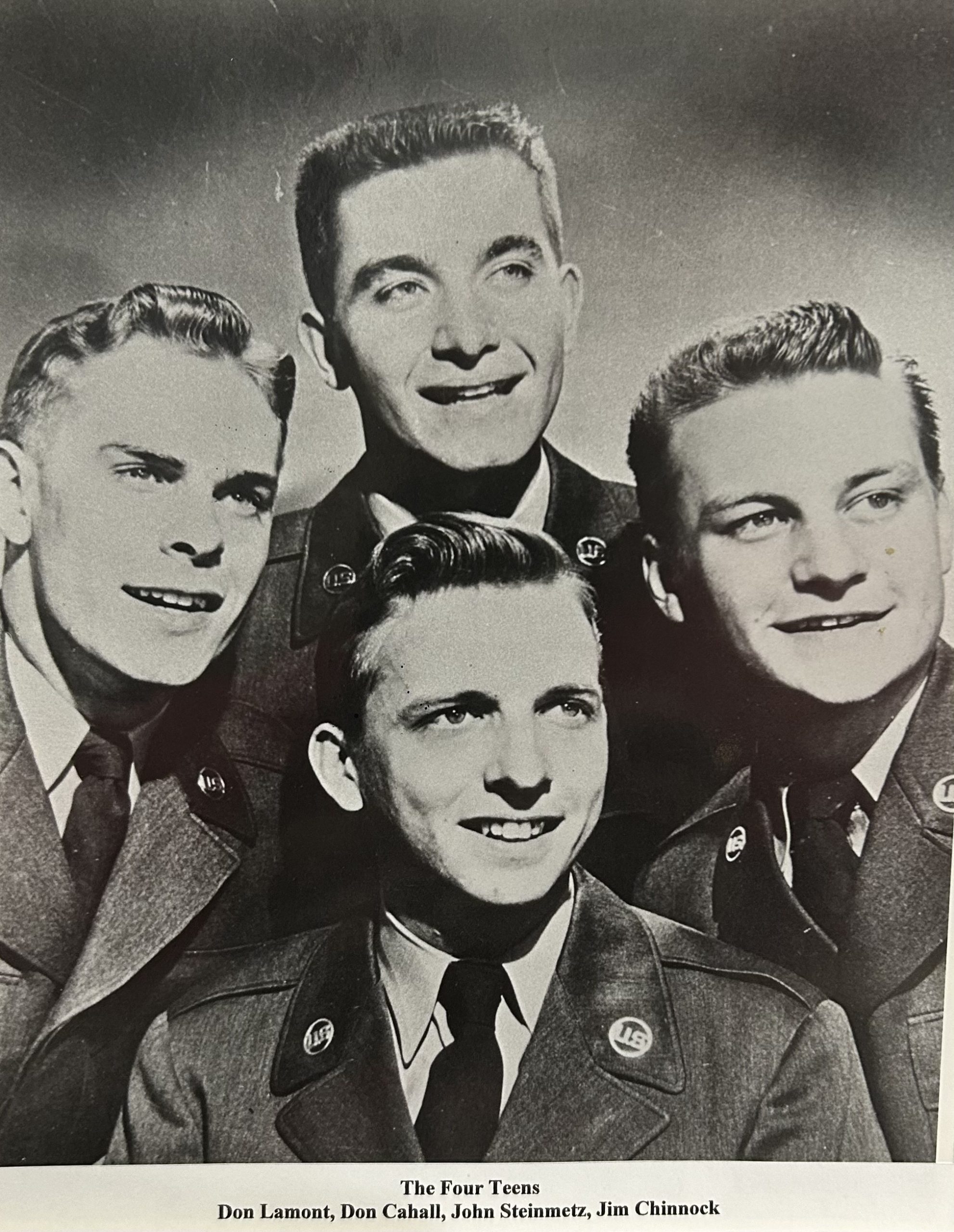
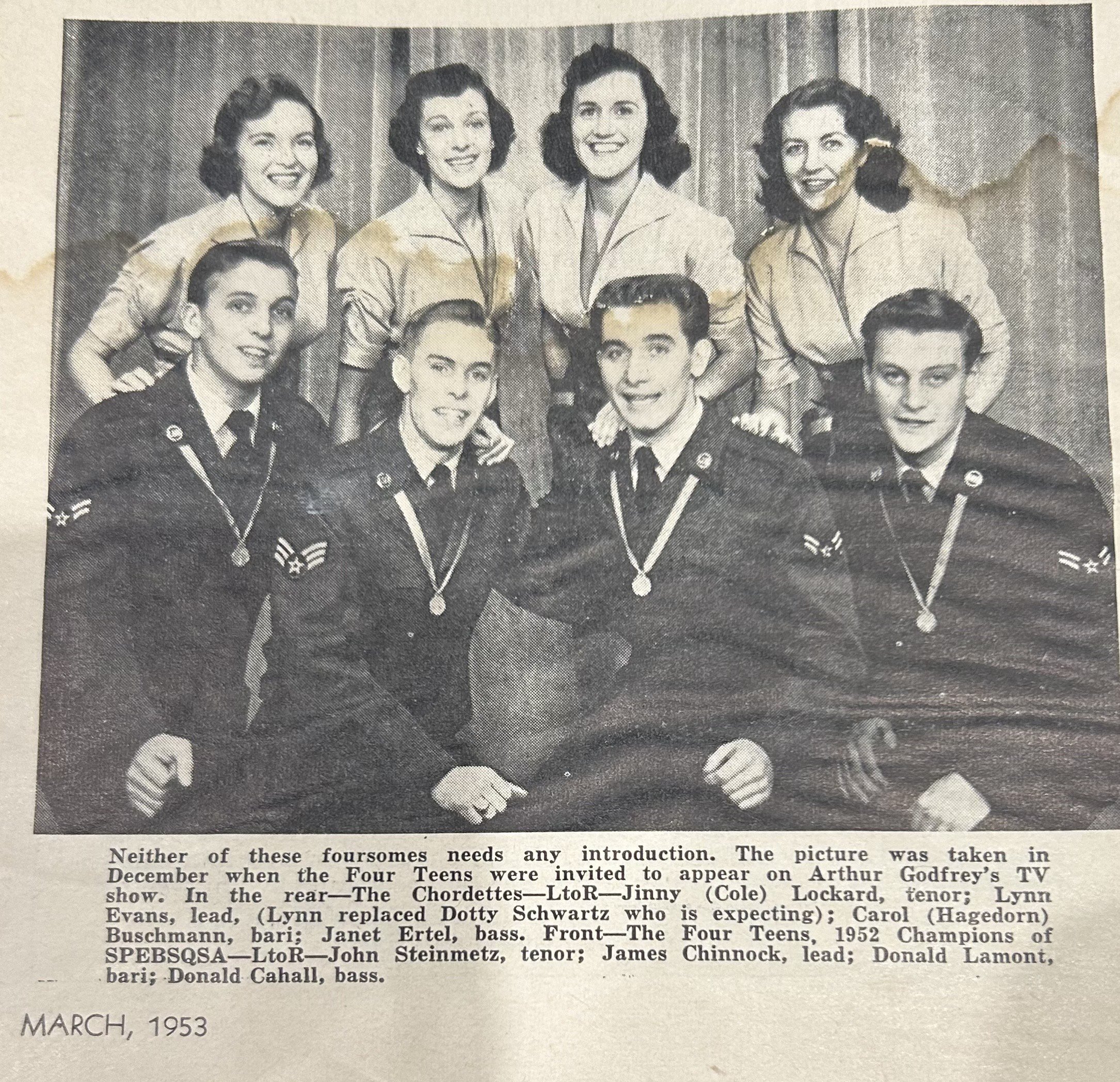
The Four Teens originated in the Eau Claire, WI Chapter in September 1949. Three members – Jim Chinnock, lead; Don Lamont, baritone; and Gene Rehberg, bass, were high school students; the fourth, tenor John Steinmetz, had graduated the previous year.

On January 8, 1950 the four young men plus a friend, Mike Egan, enlisted in the Air Force. They had decided to try to keep the quartet together and enlist as a group. The five were sent to Lackland Air Force Base near San Antonio, Texas for boot camp. There, bass Gene was found to have a foot problem and was given a medical discharge.

It looked like curtains for the quartet. They were scheduled to appear on a show built around Bob Hope and on the night before the show they found a new bass, Don Cahall from Cincinnati. They sang on the show and came to the attention of Dr. Norman Rathert, who had served as the Society’s third international president in 1941. Rathert, from St. Louis, was helping one of the generals at Scott Air Force Base in Illinois stage shows for military entertainment. At Rathert’s request, The Four Teens were assigned to Special Services at Scott, making it possible for them to rehearse six to eight hours each day.

The quartet entered the Central States District contest in 1951 as representatives of the St. Louis Chapter, and won. Requests began for performances on chapter shows and at other Air Force bases. In June 1952, the four were crowned Society champions in Kansas City.

They were the second successive quartet to win its first international contest and the youngest quartet ever to reach the top spot; Chinnock was 19 and the other three were 20. As military personnel, the quartet would not ordinarily have been allowed to leave to appear on chapter shows. However, an agreement was reached between the Air Force and the Society to allow bookings on chapter and military shows, with arrangements to be handled by the quartet’s ” business agent, bodyguard, nursemaid, and general factotum,” Mike Egan.

After their championship year, The Four Teens toured military posts throughout the world with an all-Air Force show called Tops in Blue. They also made an appearance on Arthur Godfrey’s television show. All four quartet members were discharged in 1955.

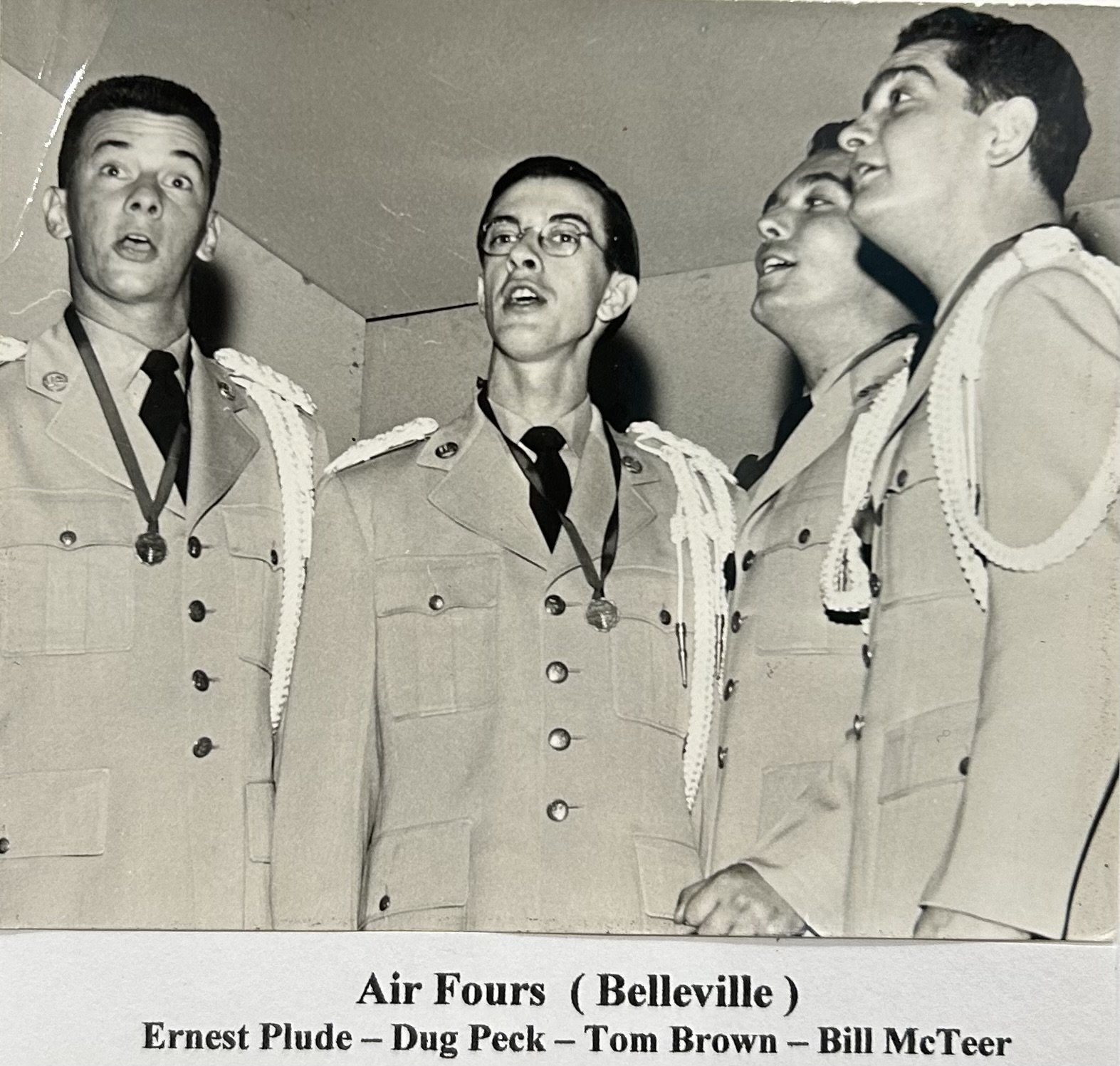
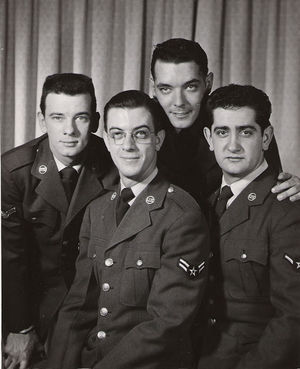
The Air Fours were a quartet made up of servicemen in the United States Air Force, based out of Scott Air Force Base in Belleville, Illinois.  The quartet formed in 1953 as an entry in the Air Force Worldwide Talent Contest starting at a base-level contest held at their base’s Service Club, eventually heading to the Air Force-level competition and winning the first place trophy at the 10-day competition.

From Summer 1954 to March 1955, The Air Fours were one of twelve acts (totaling 24 Air Force servicemen and -women) of the Tops in Blue, an Air Force entertainment group that toured military bases worldwide.  As part of the Tops in Blue, The Air Fours appeared on Ed Sullivan’s television show, “Toast of the Town”, recorded at Mitchel Air Field in Long Island, New York in July, 1954, during the Tops tour of US-based installations, prior to their departure in December for the Arctic, Europe, the Azores and North Africa with the Northeast Air Command.

The next year, 1955, the group earned 4th place medals at the annual SPEBSQSA International Barbershop competition.

We salute our young medalists in uniform – The Four Teens and The Air Fours!

The New Tradition (2001)

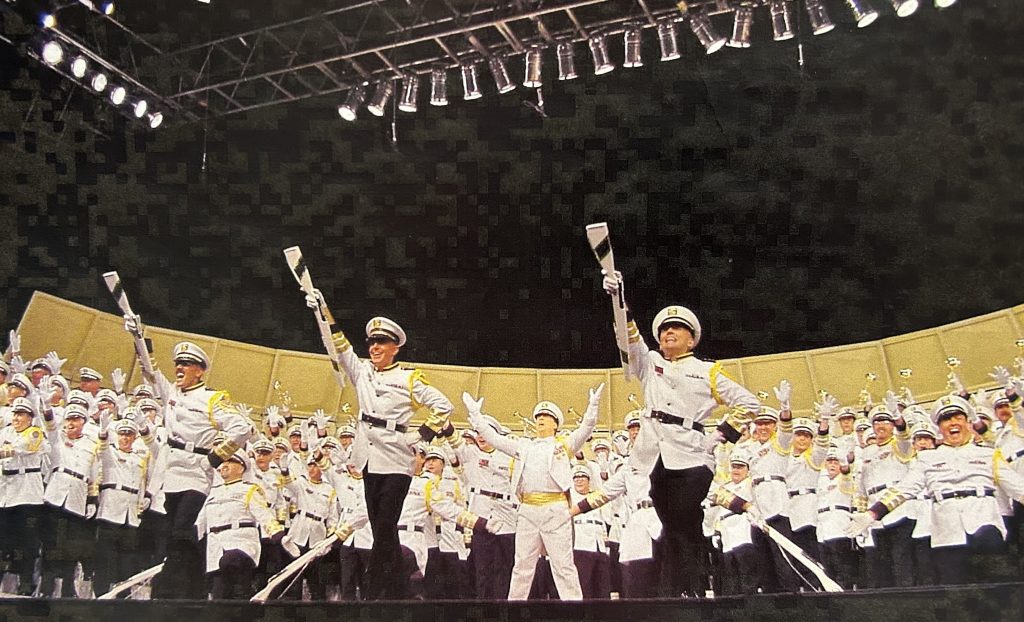
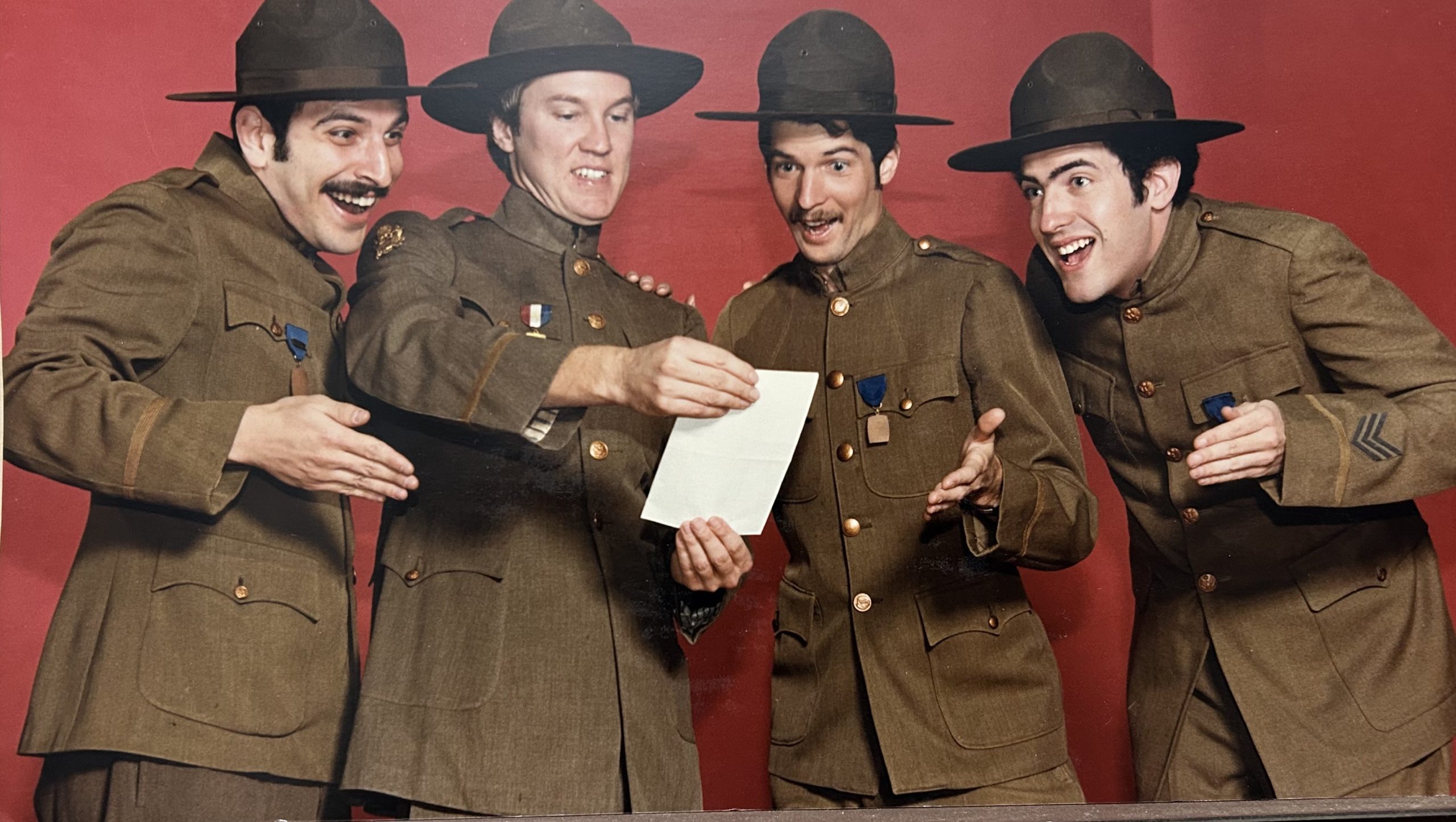
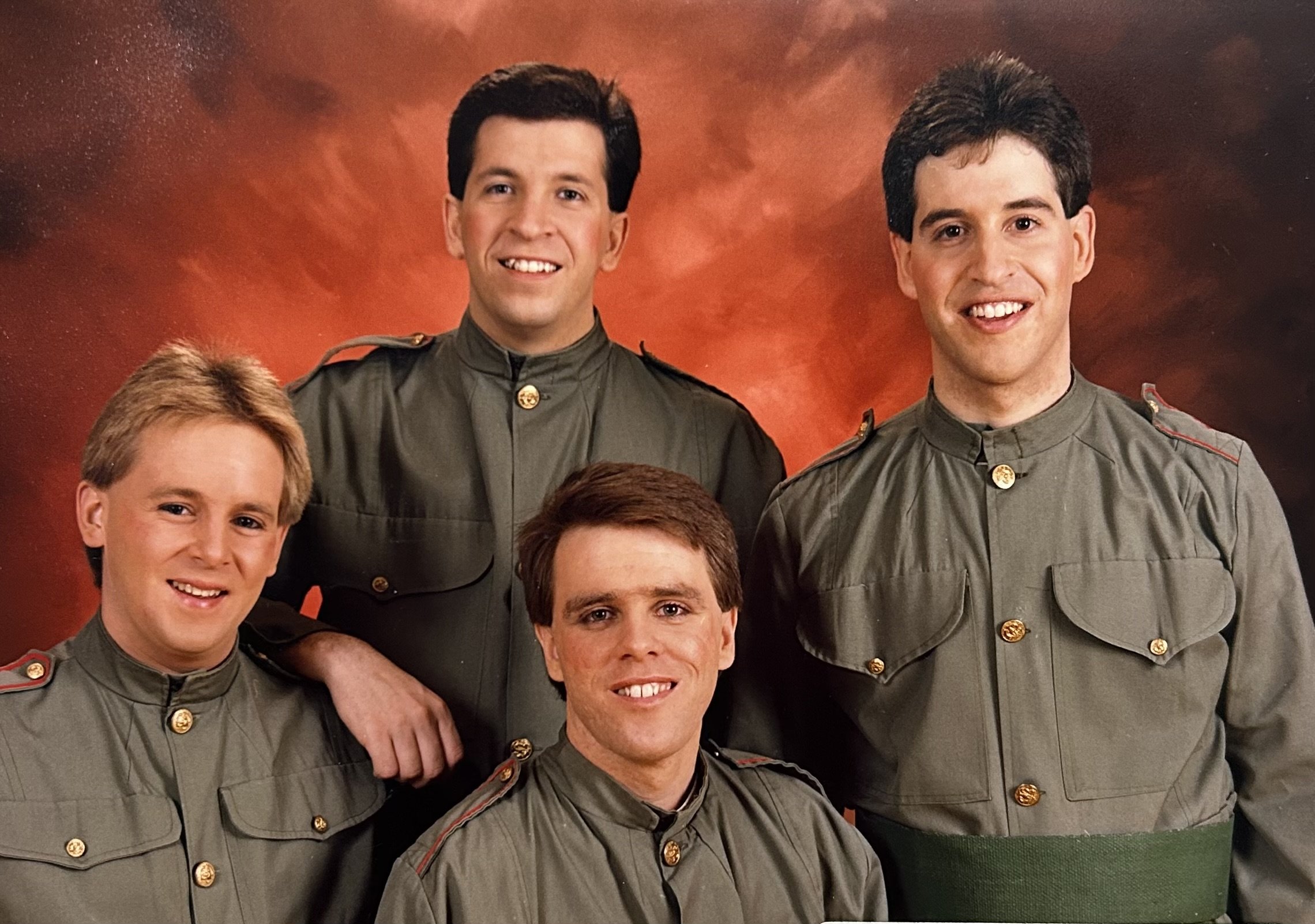
When thinking of the various contest sets honoring those who wear the uniform in defense of our country, none can compare with the performance by Northbrook’s New Tradition Chorus in the summer of 2001.  After several years of placing second in competition, Northbrook finally took home the gold at the International Convention in Nashville.  Singing a rousing set dressed in military outfits, the chapter sang director Jay Giallombardo’s arrangements of “There’s Something About a Soldier” and “The White Cliffs of Dover.”  That fall, when the chorus repeated the set at the district contest in Peoria, the performance took on a special meaning – for it was just two weeks following the infamous 9/11 attacks in New York and Washington D.C.  There was not a dry eye in the house and Northbrook received one of the longest standing ovations ever recorded at a district contest.  Here, for your enjoyment, is that gold-medal moment from their competition in Nashville.  


Northbrook’s New Tradition takes the gold at Nashville with their soldier set – July, 2001

Next Issue: Coming Winter 2025

Stay "tuned!"

WELCOME TO YOUR NEW DISTRICT WEBSITE!

We’re excited for you to be here! Much of the data on this site is pulled directly from the BHS database. If you see something that is incorrect, please let us know! You’ll find this button:

at the bottom of every page on the site. Just click it to report any errors you find! 

Once you click the X on this pop-up, you shouldn’t continue seeing it every time you visit the site!